Hipovolemia com edema periférico:
o que há de errado?
Hypovolemia with peripheral edema:
what is wrong?
Quando o paciente está "seco dentro, molhado por fora" — a tríade de hipovolemia, hipoalbuminemia e edema pode não ser fuga capilar. Esta revisão unifica cinética de volumes, pressão intersticial e falha linfática numa única explicação. When the patient is "dry inside, wet outside" — the triad of hypovolemia, hypoalbuminemia and edema may not be capillary leak. This review unifies volume kinetics, interstitial pressure and lymphatic failure into a single explanation.
ResumoAbstract
O líquido troca livremente entre o plasma e o espaço intersticial e é devolvido, principalmente, pelo sistema linfático. Esse equilíbrio pode ser perturbado por doenças e medicamentos. Em estados inflamatórios, como a sepse, o retorno do líquido do espaço intersticial para o plasma parece ser muito lento, o que promove a conhecida tríade de hipovolemia, hipoalbuminemia e edema periférico. Similarmente, a anestesia geral — por exemplo, mesmo sem ventilação mecânica — aumenta o acúmulo de cristaloides infundidos em uma fração de equilíbrio lento do compartimento extravascular. Fluid normally exchanges freely between the plasma and interstitial space and is returned primarily via the lymphatic system. This balance can be disturbed by diseases and medications. In inflammatory disease states, such as sepsis, the return flow of fluid from the interstitial space to the plasma seems to be very slow, which promotes the well-known triad of hypovolemia, hypoalbuminemia, and peripheral edema. Similarly, general anesthesia, even without mechanical ventilation, increases accumulation of infused crystalloid fluid in a slowly equilibrating fraction of the extravascular compartment.
Aqui, os autores combinam dados de ensaios de cinética de fluidos com mecanismos previamente desconectados — inflamação, fisiologia do líquido intersticial e patologia linfática — para sintetizar uma explicação nova para exemplos comuns e clinicamente relevantes de desregulação circulatória. Estudos experimentais sugerem que dois mecanismos-chave contribuem para a combinação de hipovolemia, hipoalbuminemia e edema: Herein, the authors have combined data from fluid kinetic trials with previously unconnected mechanisms of inflammation, interstitial fluid physiology and lymphatic pathology to synthesize a novel explanation for common and clinically relevant examples of circulatory dysregulation. Experimental studies suggest that two key mechanisms contribute to the combination of hypovolemia, hypoalbuminemia and edema:
Queda aguda da PifAcute Pif drop
Mediadores inflamatórios: TNFα, IL-1β e IL-6 rompem a ligação integrina–colágeno → o interstício se "suga" e drena o plasma.Inflammatory mediators TNFα, IL-1β and IL-6 reverse integrin–collagen binding → the interstitium "sucks" and drains the plasma.
Bomba linfática inibidaLymphatic pump inhibited
Óxido nítrico inibe a contração das células musculares lisas linfáticas → o retorno de fluido e albumina para o plasma trava.Nitric oxide inhibits lymphatic smooth-muscle contraction → return of fluid and albumin to plasma stalls.
A tríade paradoxalThe paradoxical triad
Paciente "seco" intravascularmente e "molhado" nos tecidos — sem que a permeabilidade capilar precise estar alterada.Patient "dry" intravascularly and "wet" in the tissues — without capillary permeability needing to change.
O dilema terapêuticoThe therapeutic dilemma
Diurético provavelmente piora a hipovolemia e causa hipotensão; fluidos pioram o edema. O tratamento clássico falha nos dois lados.A diuretic will likely worsen hypovolemia and cause hypotension; fluid administration worsens the edema. Classic treatment fails on both sides.
IntroduçãoIntroduction
O clínico se depara frequentemente com a combinação de hipovolemia e edema periférico. Em humanos saudáveis, mecanismos compensatórios — incluindo o retorno linfático do líquido extravascular e as forças de Starling transcapilares — atuam em conjunto para atenuar o edema, aumentando o volume plasmático. The clinician is frequently confronted with the combination of hypovolemia and peripheral edema. In healthy humans, compensatory mechanisms — including lymphatic return of extravascular fluid and transcapillary Starling forces — act in concert to attenuate edema by increasing plasma volume.
A explicação mais comum para essa condição confusa é a de que a permeabilidade capilar aumentou devido a dano na camada de glicocálix endotelial. No entanto, o aumento da fuga capilar normalmente acelera o fluxo linfático, o que normaliza o equilíbrio entre os volumes de fluido do corpo — e pode até aumentar a concentração de albumina no plasma (o fenômeno de "interstitial washdown", ou lavagem intersticial). The most common explanation of this confusing condition is that capillary permeability has increased due to damage to the endothelial glycocalyx layer. However, increased capillary leakage normally accelerates lymphatic flow which normalizes the balance between body fluid volumes, and might even increase the plasma albumin concentration ("interstitial washdown").
Este artigo discute como insultos inflamatórios e certos fármacos podem perturbar a troca normal de cristaloides infundidos entre o plasma e o espaço intersticial por mecanismos distintos do aumento da fuga capilar. A revisão se foca na possibilidade de que a diminuição do retorno linfático de fluido e proteína, por si só, pode criar hipovolemia, hipoalbuminemia e edema periférico. This paper discusses how inflammatory insults and certain drugs may disturb the normal exchange of infused crystalloid fluid between the plasma and the interstitial space by mechanisms other than increased capillary leakage. The review focuses on the possibility that decreased lymphatic return of fluid and protein alone can create hypovolemia, hypoalbuminemia, and peripheral edema.
A fisiopatologia responsável pelo mau retorno linfático pode envolver (i) redução da pressão hidrostática intersticial (Pif) ou (ii) falha da contratilidade intrínseca das células musculares lisas linfáticas. Esses mecanismos são distintos da obstrução linfática causada por tumores, compressão em síndromes compartimentais e resistência ao esvaziamento do ducto torácico. The pathophysiology responsible for poor lymphatic return might involve (i) a reduction of interstitial hydrostatic pressure (Pif) or (ii) failure of the intrinsic contractility of lymphatic smooth muscle cells. These mechanisms are distinctly different from lymphatic obstruction due to tumors, compression during compartment syndromes and resistance to thoracic duct outflow.
Simulação por cinética de volumesVolume kinetic simulation
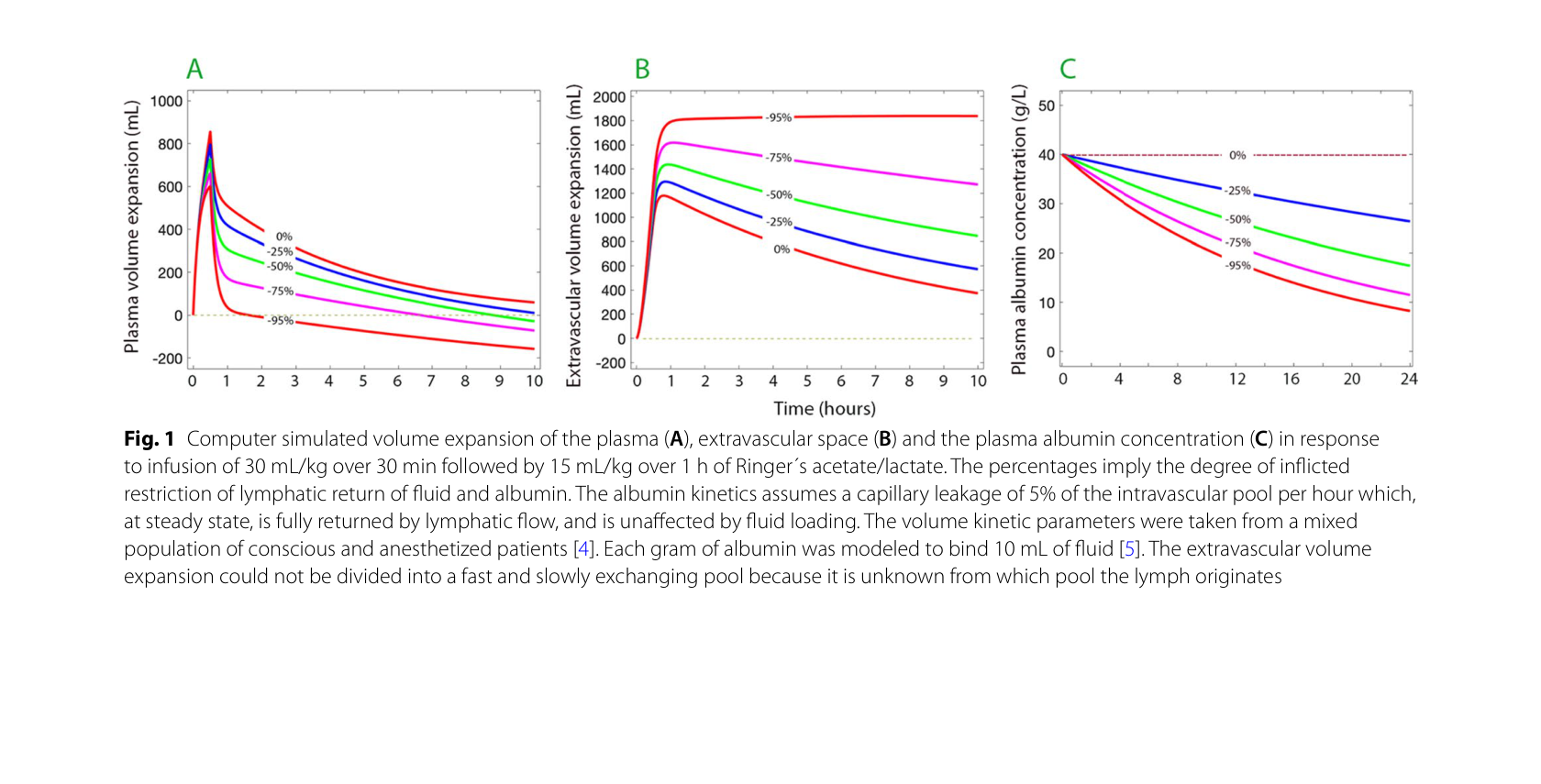
A cinética de volumes é um método macroscópico útil para o estudo da maldistribuição de fluidos em todo o organismo. Simulações baseadas na teoria cinética confirmam que a inibição do fluxo linfático tende a criar perturbações marcantes na distribuição de fluidos e albumina — mesmo quando a filtração capilar é normal e não há outra perturbação fisiopatológica presente (Fig. 1). Volume kinetics is a macroscopic method that is useful for the study of whole-body fluid maldistribution. Simulations based on volume kinetic theory confirm that inhibition of lymphatic flow is likely to create marked disturbances of fluid and albumin distribution even when capillary filtration is normal and no other pathophysiological disturbance is present (Fig. 1).
Este modelo e a síntese de evidências estão focados em mudanças distributivas entre o plasma e o espaço intersticial (e, importante, nos subcompartimentos dentro dele). Essa análise contrasta com as mudanças macroscópicas entre os volumes plasmáticos estressado e não estressado, que fazem parte das alterações hemodinâmicas ocorrendo exclusivamente dentro do compartimento vascular. This model and our synthesis of evidence are focused on distributive changes between the plasma and the interstitial space (and, importantly, sub-compartments therein). This contrasts with the macroscopic changes between the stressed and unstressed plasma volumes that are part of hemodynamic derangements occurring solely within the vascular compartment.
O ponto centralThe key point
Restringir o retorno linfático em 95% reproduz a tríade completa — hipovolemia, queda de albumina e edema — sem qualquer aumento de permeabilidade capilar.Restricting lymphatic return by 95% reproduces the full triad — hypovolemia, falling albumin and edema — without any increase in capillary permeability.
O terceiro espaço de fluidoThird fluid space
Estudos de cinética de volumes realizados em ovelhas há 20 anos demonstraram que o equilíbrio normal entre os volumes de plasma e líquido intersticial é perturbado pela anestesia com isoflurano. Brauer et al. encontraram que o desaparecimento do soro fisiológico 0,9% infundido do sistema cinético ultrapassou amplamente o fluxo urinário — e foi assumido ter entrado em um indefinido "terceiro espaço". Volume kinetic studies performed in sheep 20 years ago demonstrated that the normal balance between plasma and interstitial fluid volumes is disturbed by isoflurane anesthesia. Brauer et al. found that the disappearance of infused 0.9% saline from the kinetic system far exceeded the urine flow and was assumed to have entered an undefined "third space".
Um estudo de acompanhamento mostrou que foi o isoflurano — e não a ventilação mecânica — a causa desse fluido não contabilizado. Um estudo subsequente em humanos em cirurgia de tireoide relatou que a anestesia com isoflurano e propofol, em grau semelhante, excluiu quantidades substanciais de fluido distribuído de serem reabsorvidas para o plasma. A follow-up study showed that isoflurane and not mechanical ventilation was the cause of this unaccounted fluid. A subsequent study of humans undergoing thyroid surgery reported that isoflurane and propofol anesthesia to a similar degree excluded substantial amounts of distributed fluid from being reabsorbed to the plasma.
Naquele momento, ficou aparente que o interstício contém dois compartimentos cinéticos de fluido: um que se troca rapidamente e outro que se equilibra lentamente com o plasma — este último difícil de quantificar por outros meios que não a análise cinética de população. At this time, it became apparent that the interstitium contains two kinetic fluid pools, one that exchanges rapidly and another that equilibrates more slowly with the plasma, the latter being difficult to quantify by means other than population kinetic analysis.
Produção urinária inibidaInhibited urine output
A anestesia também reduz a produção urinária. Norberg et al. demonstraram que o isoflurano reduz a constante de velocidade (k₁₀) da excreção urinária em 50% em voluntários anestesiados, porém com respiração espontânea. Um estudo de humanos conscientes vs. anestesiados sob ventilação mecânica atribuiu a redução de k₁₀ à baixa pressão arterial. Anesthesia also reduces the urinary output. Norberg et al. demonstrated that isoflurane reduces the rate constant (k₁₀) for urinary excretion by 50% in anesthetized but spontaneously breathing volunteers. A study of conscious and anesthetized mechanically ventilated humans ascribed the reduction of k₁₀ to low arterial pressure.
Curiosamente, a redução da excreção urinária induzida pela anestesia correlaciona-se inversamente com o acúmulo de fluido no compartimento intersticial de equilíbrio lento. Interestingly, the anesthesia-induced reduction of urinary excretion is inversely correlated with the accumulation of fluid in the slowly equilibrating interstitial fluid pool.
Espaço intersticial: estrutura e funçãoInterstitial space: structure–function
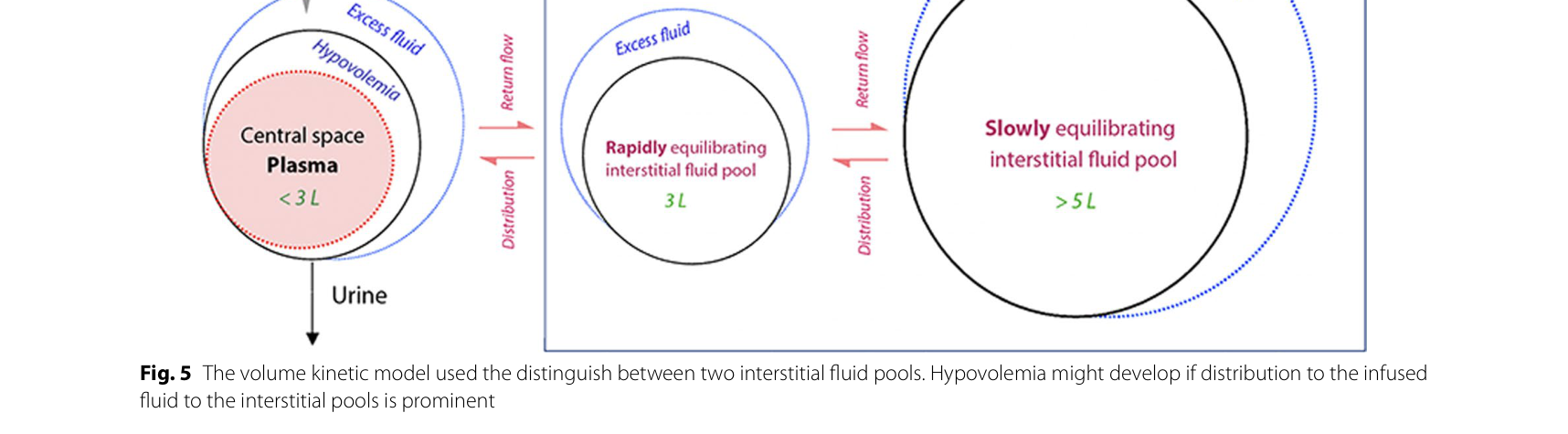
O cristaloides infundido se distribui entre o volume plasmático (3 L) e as partes expansíveis do espaço intersticial com meia-vida de ~25–30 min. A cinética de volumes identifica dois compartimentos no interstício que se equilibram com o plasma a ritmos diferentes. O compartimento de troca rápida tem tamanho similar ao volume plasmático. Infused crystalloid fluid distributes between the plasma volume (3 L) and expandable parts of the interstitial space with a half-time of approximately 25–30 min. Volume kinetics identifies two fluid compartments in the interstitial space that equilibrate with the plasma at different rates. The rapidly exchanging pool has a size similar to the plasma volume.
Dados não publicados dos autores sugerem que o volume expansível do compartimento lento é de tamanho insignificante quando algumas centenas de mL são infundidos, enquanto a infusão de volumes maiores expande um volume progressivamente maior. Em estados inflamatórios, o pool lento se expande ainda mais e se torna maior do que fisiologicamente possível — sugerindo que o fluido pode estar ligado ou sequestrado dentro do pool lento. Unpublished data from the authors' group suggest that the expandable volume of the slowly exchanging pool is negligible when a few hundred mL are infused, while infusion of larger volumes expands a progressively larger volume. During inflammatory states, the slowly exchanging pool expands even more and becomes larger than physiologically possible, suggesting that fluid can be bound or sequestered within the slow pool.
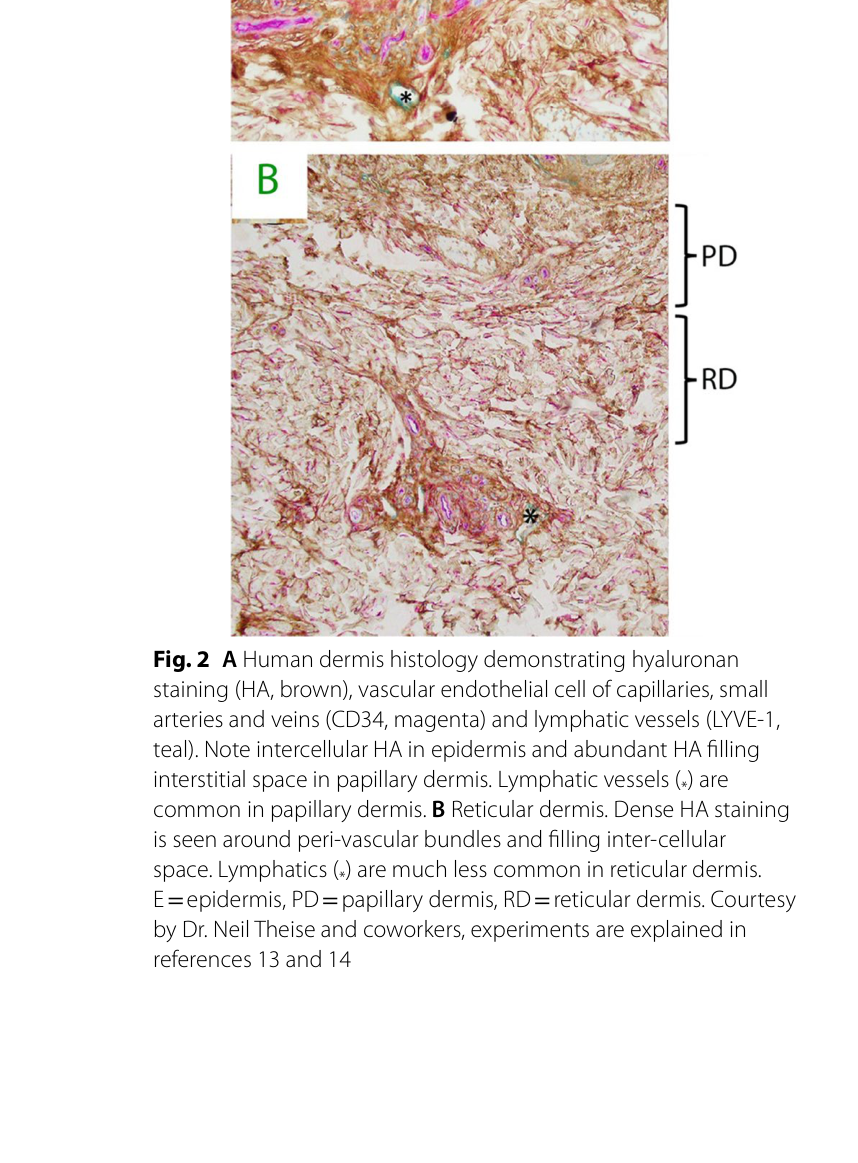
Avanços recentes revelaram muita complexidade estrutural: o hialuronano (HA) preenche grande parte do interstício e forma uma fase gel. Um achado recente é a extensa continuidade do espaço intersticial através das fronteiras de tecidos e órgãos, permitindo movimento de longa distância de fluido livre. Os vasos linfáticos limpam o interstício de fluido e proteínas, mantendo-o relativamente seco — e determinando a pressão do líquido intersticial (Pif). Recent advances in structural characterization have revealed much complexity. Hyaluronan (HA) fills much of the interstitial space and forms a gel phase. A recent finding is an extensive continuity of the interstitial space across tissue and organ boundaries, allowing long-distance movement of free fluid. Lymphatic vessels clear the interstitial space from fluid and proteins, keeping it relatively dry and determining interstitial fluid pressure (Pif).
O sistema linfático se origina em linfáticos primários, altamente permeáveis (células endoteliais frouxamente unidas), que se abrem com o aumento da pressão tecidual. Eles se unem em linfáticos secundários e depois em linfáticos coletores, que possuem células musculares lisas circunferenciais (força contrátil) e válvulas endoteliais (fluxo unidirecional). O fluido intersticial consiste em fluido livre + fluido ligado à fase gel: as fibras de colágeno criam uma rede que exclui a maioria das proteínas do soro (o "volume excluído"). Cargas de superfície de macromoléculas atraem eletrólitos — o equilíbrio de Gibbs-Donnan — que contribui com ⅓ a ½ da influência do gel sobre a Pif. A composição eletrolítica dos cristaloides de uso clínico difere tão pouco que tem efeito desprezível na cinética de fluidos. The lymphatic system originates as primary lymphatic vessels, highly permeable with loosely apposed endothelial cells that open in response to increased tissue pressure. Primary lymphatics coalesce into secondary lymphatics and then into collecting lymphatics, which possess circumferential smooth muscle cells (contractile force) and endothelial valves (unidirectional flow). Interstitial fluid consists of free fluid plus fluid associated with the gel phase: collagen fibers create a lattice that excludes most serum proteins (the "excluded volume"). Surface charges on macromolecules attract electrolytes — the Gibbs-Donnan equilibrium — contributing roughly one-third to one-half of the gel-related influence on Pif. The electrolyte composition of clinical crystalloids differs so slightly that it has little demonstrable effect on fluid kinetics.
Distribuição de fluidos na anestesia geralFluid distribution during general anesthesia
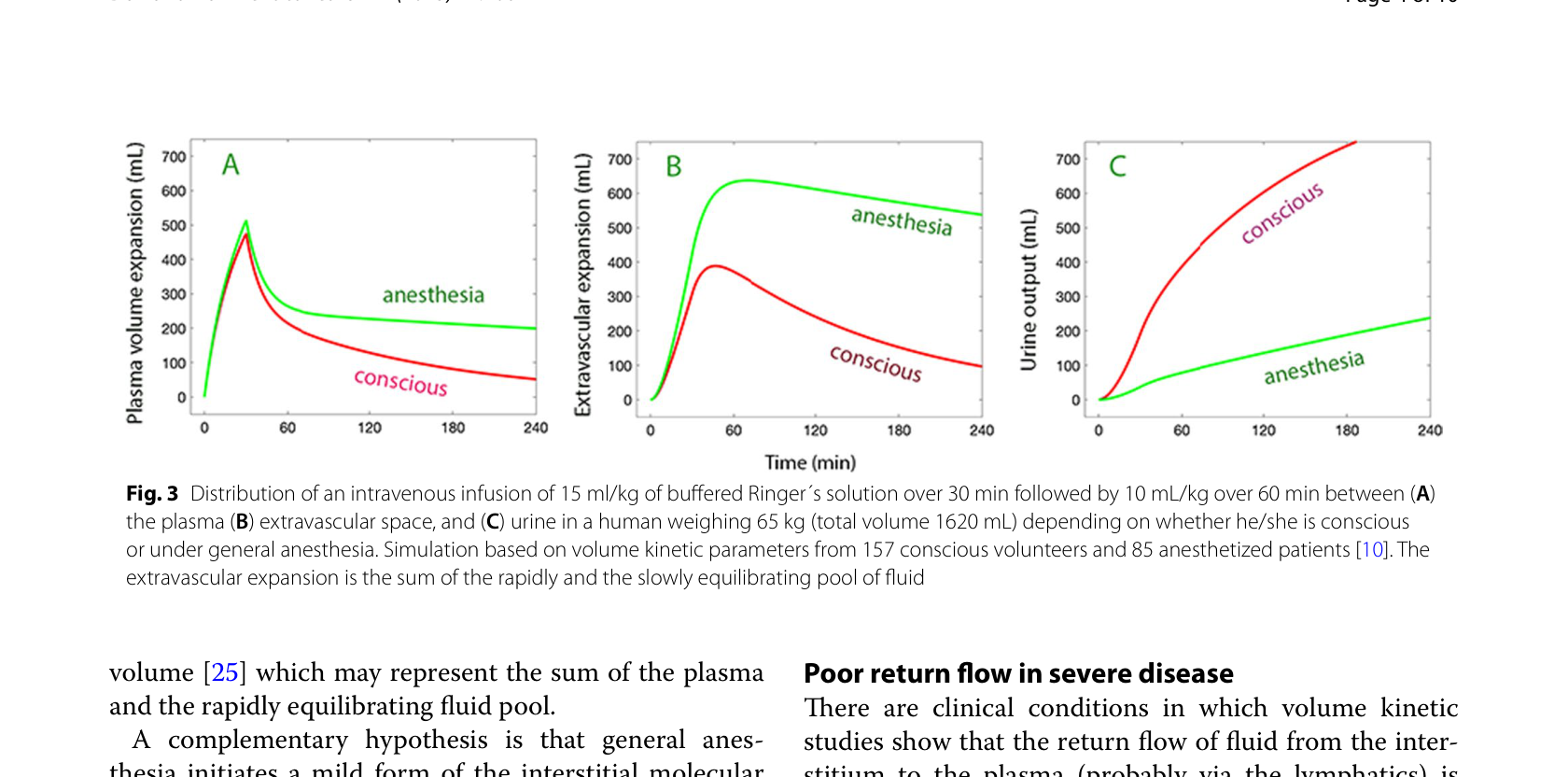
A anestesia geral cria uma maldistribuição de fluido moderadamente grave, dominada pela forte inibição da resposta diurética à expansão de volume. A queda de pressão arterial desativa os barorreceptores, que ativam os nervos simpáticos renais → maior reabsorção de sódio e água + vasoconstrição renal → redução da produção urinária. General anesthesia creates a moderately severe maldistribution of fluid that is dominated by the strong inhibition of the diuretic response to volume expansion. The anesthesia-induced decrease of arterial pressure unloads baroreceptors, which activate renal sympathetic nerves → increased sodium and water reabsorption and renal vasoconstriction → reduced urine output.
Outro achado: a constante de distribuição para o pool intersticial lento aumenta durante a anestesia. Uma possibilidade: a baixa produção urinária mantém o volume central (plasma) expandido → pressão hidrostática capilar (Pc) mais alta → força o fluido para o pool de troca lenta. Isso é suportado pelo fato de que pequenas quantidades de cristaloides (300 mL em 15 min) expandem principalmente o plasma, enquanto volumes maiores + fluxo urinário restrito promovem uma curva de diluição plasmática biexponencial — indicando a distribuição extravascular lenta e proeminente da Fig. 3. Por contraste, carga moderada com resposta diurética rápida gera curva monoexponencial, onde o único pool atinge ~2× o volume plasmático. Another finding: the rate constant for distribution to the slowly equilibrating interstitial pool increases during anesthesia. One possibility: low urine output maintains an expanded central (plasma) volume → higher capillary hydrostatic pressure (Pc) → forces fluid into the slow exchange pool. This is supported by the observation that small crystalloid amounts (300 mL over 15 min) expand mainly the plasma volume, while larger infused volumes combined with restricted urine flow promote a bi-exponential plasma dilution curve — indicating the slowly developing, prominent extravascular distribution of Fig. 3. By contrast, moderate volume loading with a prompt diuretic response creates a mono-exponential curve where the single pool reaches about twice the plasma volume.
Evidência temporalTemporal evidence
Após o despertar da anestesia geral, o mau retorno linfático persiste por várias horas — enquanto a inibição simpática da diurese se resolve quase instantaneamente. A "cauda" longa aponta para o mecanismo intersticial, não renal.After awakening from general anesthesia, poor interstitial return flow persists for several hours — while the sympathetic inhibition of diuresis resolves almost instantly. The long tail points to the interstitial mechanism, not the renal one.
Mau retorno no adoecimento gravePoor return flow in severe disease
Existem condições clínicas em que a cinética de volumes mostra que o retorno do interstício para o plasma (provavelmente via linfáticos) está severamente reduzido: There are clinical conditions in which volume kinetic studies show that the return flow of fluid from the interstitium to the plasma (probably via the lymphatics) is severely reduced:
| CondiçãoCondition | ModeloModel | Achado cinéticoKinetic finding |
|---|---|---|
| "Síndrome de ressecção transuretral""Transurethral resection syndrome" | PorcosPigs | Retorno intersticial drasticamente reduzidoDrastically reduced interstitial return |
| Sepse (LPS + cecostomia)Sepsis (LPS + cecal puncture) | OvelhasSheep | Fluxo de retorno negativo do pool lento (efeito sucção)Negative return flow from the slow pool (suction effect) |
| Pré-eclâmpsiaPreeclampsia | HumanosHumans | Quase ausência total de retorno; entrada no pool lento 4× mais rápidaNear-total absence of return; 4× faster entrance to the slow pool |
Essas três condições são todas caracterizadas por hipovolemia, hipoalbuminemia e edema periférico. Uma hipótese complementar: a anestesia geral inicia uma forma leve dos eventos moleculares intersticiais da inflamação — sequestração de fluido na fase gel por queda de Pif + inibição da bomba linfática. Há muita evidência de que moléculas inflamatórias reduzem a Pif na inflamação aguda (sepse, queimaduras). These three conditions are all characterized by hypovolemia, hypoalbuminemia, and peripheral edema. A complementary hypothesis: general anesthesia initiates a mild form of the interstitial molecular events of inflammation — sequestration of fluid in the gel phase from reduced Pif plus inhibition of lymphatic pumping. There is much evidence that inflammatory molecules reduce Pif in acute inflammation (sepsis, burns).
Movimento de fluido no sistema linfáticoFluid movements in the lymphatic system
O movimento do fluido intersticial livre para o sistema linfático é promovido por dois tipos de forças teciduais: extrínsecas e intrínsecas. Movement of free interstitial fluid into the lymphatic system is promoted by two types of tissue forces: extrinsic and intrinsic.
⚙️ Forças extrínsecasExtrinsic forces
Vêm do movimento do tecido: contração muscular esquelética, respiração, peristaltismo, pulsações arteriais, massagem externa. Todas aumentam a pressão do tecido e abrem os "poros" entre as células endoteliais frouxas dos linfáticos primários. Meias de compressão agem exatamente assim. They come from tissue movement: skeletal muscle contraction, breathing, peristalsis, arterial pulsations, external massage. All increase tissue pressure and open the "pores" between the loosely apposed endothelial cells of primary lymphatics. Compression garments act exactly this way.
💪 Forças intrínsecasIntrinsic forces
A contratilidade das células musculares lisas linfáticas. Essas células têm traits tanto de músculo liso quanto cardíaco: contrações espontâneas moduladas por pré-carga, pós-carga e contratilidade. Juntas com as válvulas unidirecionais, determinam a taxa de fluxo linfático. The contractility of lymphatic smooth muscle cells. These cells have traits of both smooth and cardiac muscle: spontaneous contractions modulated by preload, afterload and contractility. Together with unidirectional valves, they determine lymph flow rates.
Pressão do líquido intersticial (Pif)Interstitial fluid pressure (Pif)
Antes do fim dos anos 1960, a Pif era assumida como ~zero ou levemente positiva. Guyton e colegas, testando ampla gama de condições experimentais, mediram consistentemente Pif negativa: −3 a −7 mmHg (mais recentemente −2 a −3 mmHg). Before the mid-1960s, Pif was assumed to be near zero or slightly positive. Guyton and colleagues, testing a wide range of experimental conditions, consistently measured negative Pif: −3 to −7 mmHg (more recently reported as −2 to −3 mmHg).
A Pif negativa é mantida por uma pressão de imersão (sucção) criada por coloides na fase gel, mais o estresse tensil criado por processos mediados por fibroblastos e dependentes de integrinas. Esses mecanismos mantêm o interstício "seco": o fluido livre ocupa tão pouco quanto 1% do volume intersticial; o resto fica ligado na fase gel. A cinética de volumes, porém, sugere que a fase livre normalmente corresponde a ~o volume do plasma — podendo ocupar espaço menor em inflamação, quando mais fluido é sequestrado no pool lento. The negative Pif is maintained by an imbibition (suction) pressure created by colloids in the gel phase, plus tensile stress created by fibroblast-mediated, integrin-dependent processes. These mechanisms keep the interstitium "dry": free fluid may occupy as little as 1% of the interstitial volume; the rest is bound in the gel phase. Volume kinetic analyses, however, suggest the free fluid phase normally amounts to approximately the plasma volume — though it may occupy a smaller space in inflammatory conditions as more fluid is sequestered in the slowly exchanging pool.
Mecanismos que criam Pif negativaMechanisms creating negative Pif
A análise da pressão e volume intersticiais durante a falha linfática se apoia principalmente em estudos da pele — um dos maiores sistemas orgânicos do corpo, estimado em ~3 L de fluido, segundo somente ao músculo esquelético (~20 L). O edema periférico é observado mais precocemente na pele, e os espaços intersticiais da derme e subderme são bem caracterizados em histologia e fisiologia. Analysis of interstitial pressure and volume during lymphatic failure draws data primarily from studies of the skin — among the largest organ systems, estimated at ~3 L of fluid, second only to skeletal muscle (~20 L). Peripheral edema is usually observed earliest in the skin, and the dermis and sub-dermis interstitial spaces are well characterized in terms of histology and physiology.
Injetar lipopolissacarídeo ou moléculas inflamatórias intravenosa (ou diretamente na pele) reduz a Pif de −2 mmHg para −7,5 a −10 mmHg em minutos. A queda mais dramática ocorre na lesão por queimadura, com valores de −40 mmHg ou maiores. Essas mudanças de pressão sucam o fluido intravascular para o interstício e reduzem ainda mais o fluxo linfático. Injecting lipopolysaccharide or inflammatory molecules intravenously (or directly into the skin) reduces Pif from −2 mmHg to between −7.5 and −10 mmHg within minutes. The most dramatic decrease occurs in burn injury, where values of −40 mmHg and greater have been reported. Such pressure changes suck intravascular fluid into the interstitium and further reduce lymphatic flow.
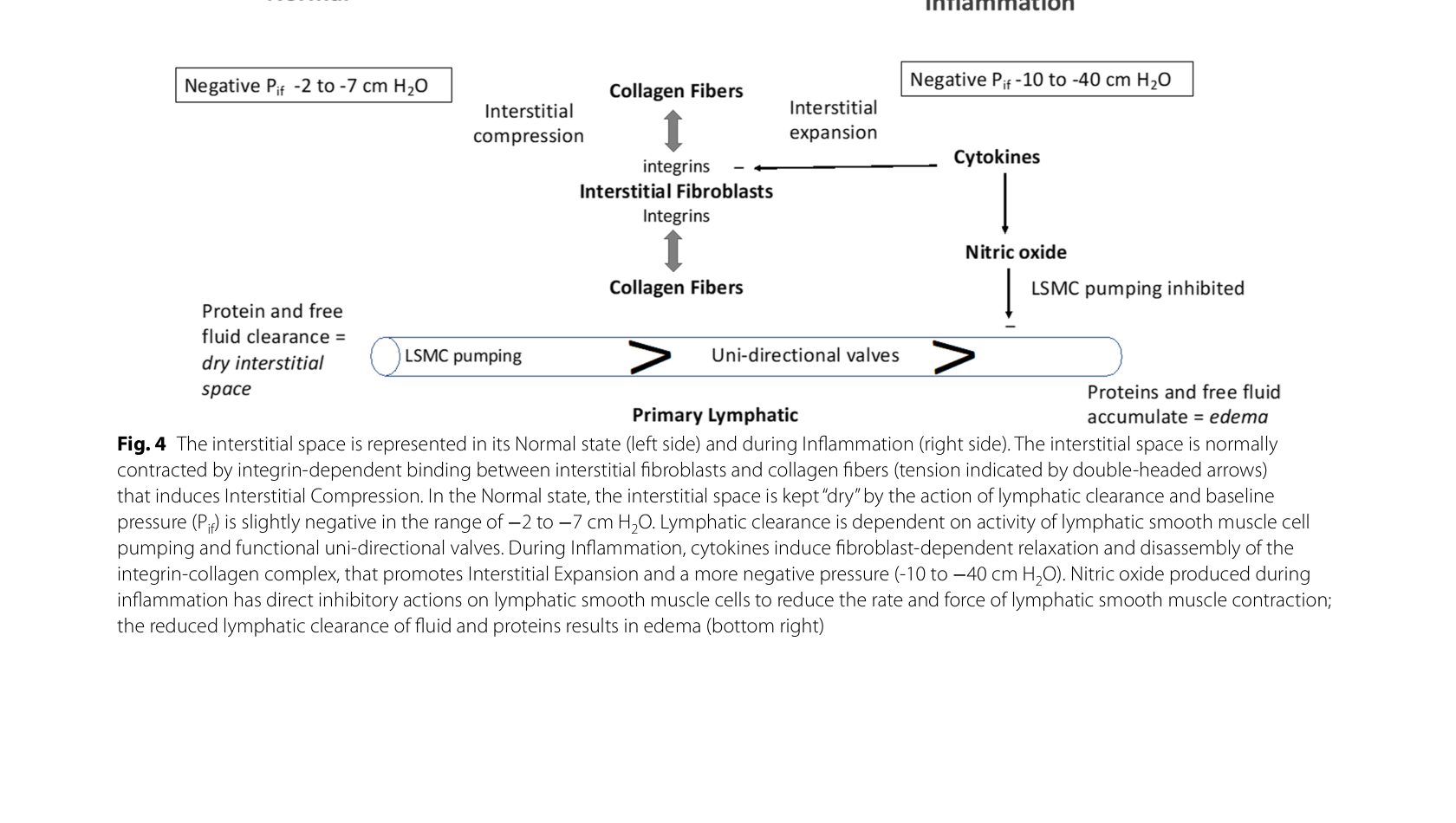
Como isso acontece? O interstício está sob forças tensis mediadas por interações célula–colágeno — especificamente por integrinas. A força tensil basal define a relação pressão–volume (tecido excisado e colocado em soro fisiológico se expande por perda dessas forças). Reed et al. mostraram que inúmeros mediadores inflamatórios reversam a ligação integrina–colágeno: histamina (degranulação de mastócitos, composto 48/80), PAF, TNFα, IL-1β, IL-6, LPS e IFN-γ. Anticorpos monoclonais neutralizantes de integrinas reduziram a Pif quando injetados intradermalmente, demonstrando o papel das integrinas. How can this occur? The interstitial space is under tensile forces mediated by cell–collagen interactions — specifically by integrins. The basal tensile force sets the pressure–volume relationship (excised tissue placed in isotonic saline expands due to loss of these forces). Reed et al. showed that numerous inflammatory mediators reverse integrin–collagen binding: histamine (mast cell degranulation, Compound 48/80), PAF, TNFα, IL-1β, IL-6, LPS and IFN-γ. Integrin-neutralizing monoclonal antibodies reduced Pif when injected intradermally, demonstrating the role of integrins in the Pif-lowering process.
Os fibroblastos se ligam ao colágeno via 4 integrinas que ligam colágeno (α₁β₁, α₂β₂, α₁₀β₁, α₁₁β₁) — heterodímeros que ligam o citoesqueleto da célula ao colágeno. Durante a inflamação aguda, há uma mudança bifásica de Pif: Fibroblasts bind collagen via four collagen-binding integrins (α1β1, α2β2, α10β1, α11β1) — heterodimers linking the cell's cytoskeleton to collagen. During acute inflammation there is a biphasic change in Pif:
📉 Fase 1 — SucçãoPhase 1 — Suction
Pif fica mais negativa (−2/−7 → −10 a −40 cmH₂O) pela perda de forças tensis com relaxamento intersticial dependente de citocinas. Rápido: aumenta filtração e imersão de fluido dos capilares. Pode causar hipovolemia potencialmente fatal nas primeiras 6–8 h após queimadura. Pif becomes more negative (−2/−7 → −10 to −40 cmH₂O) by loss of tensile forces via cytokine-dependent interstitial relaxation. Fast: it increases filtration and imbibition from capillaries. It can cause life-threatening hypovolemia in the first 6–8 h after burn injury.
⏸️ Fase 2 — SaturaçãoPhase 2 — Saturation
Dominada pela expansão do volume intersticial, Pif desliza de volta rumo a zero — onde as características de compliância cessam. HA e glicosaminoglicanos no plasma sugerem que a expansão também envolve fragmentação de matriz. Mudanças negativas de Pif provavelmente se instalam, em graus variados, em todas as condições de inflamação aguda. Dominated by interstitial volume expansion, Pif shifts back toward zero — where compliance characteristics cease. HA and glycosaminoglycans in plasma suggest expansion also involves matrix fragmentation. Negative Pif changes are likely induced, to varying degrees, in all acute inflammation conditions.
Falha linfáticaLymphatic failure
O edema intersticial e a hipovolemia se agravam se o bombeamento linfático estiver prejudicado. Na sepse e em estados de inflamação sustentada, níveis elevados de óxido nítrico (NO) — provavelmente gerados pela iNOS — inibem a contração das células musculares lisas linfáticas, contribuindo para a falha linfática. Interstitial edema and hypovolemia become aggravated if lymphatic pumping is impaired. During sepsis and sustained inflammation, increased nitric oxide (NO) — likely generated by iNOS — inhibits lymphatic smooth muscle cell pumping, contributing to lymphatic failure.
O retorno lento de linfa rica em albumina é a provável causa da maldistribuição de albumina nos estados inflamatórios — a taxa de síntese de albumina é normal em cirurgia abdominal maior e sepse. Além disso, experimentos mostram que fármacos anestésicos inibem o bombeamento linfático. Slow return of albumin-rich lymph is the likely cause of albumin maldistribution in inflammatory conditions — the synthetic rate of albumin is normal during major abdominal surgery and sepsis. Moreover, laboratory experiments show that anesthesia drugs inhibit lymphatic pumping.
O efeito combinado de Pif baixa e bombeamento linfático precário expande enormemente o interstício. Conforme o interstício se enche, a Pif desliza pela curva pressão–volume em direção a valores positivos (em queimaduras experimentais, a transição durou horas) — diminuindo as forças de influxo. O resultado: fluido entra sem resistência → alterações patológicas da arquitetura intersticial (ex.: edema fúngico/pitting), lacunas cheias de fluido entre células (possível hipoxia celular) e ruptura do citoesqueleto de órgãos encapsulados. The combined effects of low Pif and poor lymphatic pumping greatly expand the interstitial space. As the interstitium fills, Pif shifts along its pressure–volume curve toward positive values (in experimental thermal injury the transition took hours) — diminishing the forces for further influx. The result: fluid enters with virtually no resistance → pathological alterations of interstitial architecture (e.g. "pitting" edema), fluid-filled lacunae between cells (possible cellular hypoxia) and disruption of the cytoskeleton of encapsulated organs.
A redução de Pif aumenta a fuga capilar de plasma por efeito de sucção — sem necessariamente alterar a permeabilidade capilar: Arturson e Mellander (1964) mostraram perda acelerada de fluido intravascular na pata de gato queimado sem mudança no coeficiente de filtração capilar. Reduction of Pif increases capillary leakage of blood plasma by a suction effect — without necessarily altering capillary permeability: Arturson and Mellander (1964) showed accelerated loss of intravascular fluid in the burned cat paw without any change in the capillary filtration coefficient.
Síndromes de fuga capilarCapillary leakage syndromes
A tríade ocorre em várias doenças e é geralmente atribuída a aumento de permeabilidade capilar. A sepse é o "modelo tipo", mas outras incluem picadas de serpentes, febres hemorrágicas virais, síndrome de engraftment e doenças autoimunes. Fuga capilar excessiva pode também ser induzida por terapias oncológicas com fármacos ou imunoglobulinas — e administração terapêutica de IL-2, IL-11 e IL-12 até já induziu síndromes de fuga. The triad occurs in several diseases and is generally attributed to increased capillary permeability. Sepsis is the "type model", but others include snakebites, viral hemorrhagic fever, engraftment syndrome and autoimmune diseases. Excessive capillary leakage may also be induced by cancer therapies — and therapeutic administration of IL-2, IL-11 and IL-12 has even induced capillary leakage syndromes.
Casuística especial: Doença de ClarksonSpecial case: Clarkson's disease
A rara Síndrome de Fuga Capilar Idiopática apresenta dramaticamente com crises de choque hipovolêmico + edema fúngico — mas não é associada a inflamação. O soro agudo de pacientes aumenta a fuga capilar em sistemas experimentais. Tratamento eficaz: imunoglobulina polivalente; a hiperpermeabilidade endotelial também pode ser contra-atacada aumentando cAMP intracelular com terbutalina (agonista β₂) e teofilina. The rare Idiopathic Capillary Leak Syndrome presents dramatically with attacks of hypovolemic shock and pitting edema — but is not associated with inflammation. Acute patient serum increases capillary leakage experimentally. Effective treatment: polyvalent immunoglobulin; endothelial hyperpermeability can also be counteracted by raising intracellular cAMP with terbutaline (a beta₂-agonist) and theophylline.
Pressão intersticial nos órgãosInterstitial pressure in body organs
Muito da análise usa dados da pele, onde Pif é acessível. Em órgãos encapsulados a situação é diferente — o edema não pode "transbordar" e a Pif sobe. Much of the analysis draws on skin data, where Pif is accessible. In encapsulated organs the situation is different — edema cannot "spill over" and Pif rises.
🫘 Rim (cápsula renal)Kidney (renal capsule)
Rede extensa de linfáticos especializados intrarenais. Pela cápsula, a Pif sobe rápido com compressão capsular externa, obstrução linfática (metástase), hipertensão venosa sistêmica (IC), obstrução ureteral ou fuga capilar. O edema parenquimatoso pode colapsar os linfáticos cápsulares e hilares → mais obstrução. Edema intersticial renal + Pif alta é achado típico da lesão renal aguda (AKI), frequentemente com falha linfática intrarenal por compressão. A sepse é a principal causa de AKI — e compartilha NO e metabólitos oxidativos reativos como grandes contribuintes. An extensive network of specialized intrarenal lymphatics. Due to the capsule, Pif rises quickly with external capsular compression, lymphatic obstruction (metastasis), systemic venous hypertension (CHF), ureteral obstruction or increased capillary permeability. Parenchymal edema may collapse capsular and hilar lymphatics → further obstruction. Renal interstitial edema and increased Pif is a typical finding in acute kidney injury, commonly with intra-renal lymphatic failure from compressive obstruction. Sepsis is a leading cause of AKI — sharing nitric oxide and reactive oxidative metabolites as major contributors.
🦵 Músculo esqueléticoSkeletal muscle
Outro sistema encapsulado — fascias conectivas ao redor de cada feixe. Diferencial crucial: seus linfáticos não possuem músculo liso linfático. Os gradientes de pressão vêm apenas de forças extrínsecas (contração muscular). Com o feixe envolto em fascia, qualquer edema celular ou fuga capilar eleva rapidamente a Pif — e os linfáticos, igualmente encapsulados, não conseguem responder. Síndrome compartimental. Another encased system — connective sheaths around each fiber bundle. Crucial difference: their lymphatics lack lymphatic smooth muscle cells. Pressure gradients come solely from extrinsic forces (muscle contraction). With the bundle encased, any cellular swelling or capillary leakage rapidly raises Pif — and the lymphatics, likewise encased, cannot respond. Compartment syndrome.
🌀 IntestinoGut
Pode desenvolver edema e síndrome compartimental. As paredes intestinais são revestidas por uma extensa população de leucócitos que, na inflamação aguda, geram altos níveis de NO e citocinas. Em geral, a síndrome compartimental abdominal resulta de fatores mecânicos do edema tecidual progressivo — incluindo falha linfática. Os linfáticos mesentéricos drenam no ducto torácico → veia subclávia esquerda. Aumento da pressão venosa central reduz o gradiente de fluxo linfático e pode piorar o edema periférico (insuficiência cardíaca, hipertensão portal, sobrecarga, VPP/PEEP). O limiar no qual o volume sistólico linfangion começa a cair é ≈ 10 cmH₂O acima — além disso, hipertensão linfática. Aumento sustentado da pressão transmural gera adaptação (taxa contrátil ↑), mas os vasos linfáticos não superam facilmente grandes aumentos de resistência de esvaziamento: hipertensão venosa mesentérica sustentada primeiro aumenta o fluxo linfático e, em dias, atenua o bombeamento. The gut can develop both edema and compartment syndrome. Intestinal walls are lined with an extensive leukocyte population that, in acute inflammation, generates high NO and cytokine levels. In general, abdominal compartment syndrome results from mechanical factors of progressive tissue edema — including lymphatic failure. Mesenteric lymphatics drain into the thoracic duct → left subclavian vein. Increased central venous pressure reduces the lymph flow gradient and may worsen peripheral edema (heart failure, portal hypertension, volume overload, PEEP). The outflow pressure at which lymphangion stroke volume begins to decrease is ≈ 10 cmH₂O above — beyond that, lymphatic hypertension. Sustained transmural pressure changes trigger adaptation (higher contractile rate), but lymphatic vessels cannot easily overcome large outflow-resistance increases: sustained mesenteric venous hypertension initially increases lymph flow and, over days, attenuates pumping.
Estudos macroscópicosMacroscopic studies
Os eventos microcirculatorios e moleculares descritos ganham sentido com as análises macroscópicas. Nos últimos 10 anos, a cinética de volumes quantificou a entrada de fluido isotônico no pool intersticial lento pela constante k_b. Em voluntários conscientes, k_b ≈ 10% da taxa de entrada no pool rápido e ≈ 25% da taxa urinária. Sob anestesia geral, k_b fica ~50% maior e o fluxo pode superar a excreção urinária (Fig. 5). The microcirculatory and molecular events described make sense when interpreted with macroscopic analyses. Over the past decade, volume kinetics has quantified entrance of isotonic fluid to the slowly equilibrating interstitial pool via rate constant k_b. In conscious volunteers, k_b ≈ 10% of the fast pool entrance rate and ≈ 25% of the urine flow rate. Under general anesthesia, k_b becomes ~50% larger and the flow may even exceed urinary excretion (Fig. 5).
O agrupamento de muitos experimentos sugere que o fluido sai do pool lento e retorna ao plasma com meia-vida de ~2 h (vs. ~10 min do pool rápido, N=233). O circuito linfático opera como uma "linha telefônica" — o retorno para o plasma aumenta em minutos após a carga IV. Em estados inflamatórios, a meia-vida no pool lento é muito mais longa: reanálise de pacientes operados por colangite ou apendicite chegou a resultar em taxa de retorno negativa do pool lento. Pooling of many experiments suggests fluid leaves the slow pool and returns to the plasma with a half-time of ~2 h (vs. ~10 min for the fast pool, N=233). The lymphatic circuit operates like a "telephone line" — return to plasma increases within minutes after IV loading. In inflammatory states, the half-time in the slow pool is much longer: re-analysis of patients operated for cholecystitis or appendicitis even yielded a negative return flow rate for the slowly equilibrating phase.
🐑 Sepse em ovelhas (Li et al.)Sepsis in sheep (Li et al.)
Sepse induzida (LPS + punção cecal) em 25 ovelhas anestesiadas; 1 h depois, cinética de 20 mL/kg de RL em 30 min: praticamente nula excreção urinária, taxas de fluxo para os pools intersticiais e de retorno ao plasma tiny ou negativas (efeito sucção). A expansão ocorreu às custas do pool rápido, que ficou com ⅓ do volume plasmático. De 4 catecolaminas testadas, somente dopamina normalizou levemente a distribuição patológica. Sepsis induced (LPS + cecal puncture) in 25 anesthetized sheep; 1 h later, kinetics of 20 mL/kg RL over 30 min: virtually no urinary excretion, extremely small or negative flow rates to the interstitial pools and back to plasma (suction effect). Expansion occurred at the expense of the fast pool, left at ⅓ of plasma volume. Of 4 tested catecholamines, only dopamine slightly "normalized" the pathological distribution.
🤰 Pré-eclâmpsia (8 vs 8)Preeclampsia (8 vs 8)
Tríade + hipertensão. 8 mulheres com pré-eclâmpsia leve-moderada vs 8 controles pareadas por semanas gestacionais: quase ausência total de retorno do Ringer do interstício ao plasma. A entrada no pool lento foi 4× mais rápida do que em gestantes saudáveis ou não gestantes, e o pool rápido encolheu para volume insignificante. Triad + hypertension. 8 women with mild–moderate preeclampsia vs 8 gestational-week-matched controls: near-complete lack of return of infused Ringer's from interstitium to plasma. Entrance to the slow pool was 4× faster than in healthy pregnant or non-pregnant women, and the fast pool shrank to a negligible volume.
🌾 Kwashiorkor — a tríade sem inflamação clássicaKwashiorkor — the triad without classic inflammation
Doença nutricional que compartilha a distribuição patológica com a sepse. Hipoalbuminemia é achado obrigatório — mas não basta para explicar o edema. Gonzalez et al.: concentrações plasmáticas de lumican (proteína de matriz intersticial) e metaloproteinase-2 (degradação da matriz) aumentam com o grau de edema; ao contrário, biomarcadores de integridade endotelial (sindican-1 e hialuronano) mostram relação inversa com o edema → eventos moleculares no interstício, além da inflamação, explicam a distribuição. A nutritional disease sharing the pathological distribution with sepsis. Hypoalbuminemia is an obligate finding — but not enough to explain the edema. Gonzalez et al.: plasma lumican (interstitial matrix protein) and metalloproteinase-2 (matrix breakdown) rise with the degree of edema; by contrast, endothelial integrity biomarkers (syndecan-1 and hyaluronan) show an inverse relationship → molecular events in the interstitium, beyond inflammation, account for the pathological fluid distribution.
LimitaçõesLimitations
Um aviso é frequentemente dado quando dados farmacocinéticos são interpretados em termos fisiológicos — frequentemente justificado por questões de ligação tecidual e metabolismo de fármacos. A cinética de volumes fornece volumes funcionais e taxas para fluidos e há muito dá estimativas razoáveis de volume plasmático e descrições de eventos fisiológicos. Atualmente, é o melhor método disponível para entender eventos dinâmicos em todo o corpo relacionados a infusões. A warning is often given when pharmacokinetic data is interpreted into physiological terms — frequently warranted by tissue binding issues and drug metabolism. Volume kinetics provide functional volumes and rates for fluids and have long given reasonable estimates of plasma volumes and descriptions of physiological events. Currently, it is the best available method by which dynamic whole-body events related to fluid infusions can be understood.
Os dados sugerem que: (i) o pool de equilíbrio rápido corresponde à "fase de fluido livre" do interstício, provavelmente fluido em proximidade íntima aos capilares; (ii) o pool de equilíbrio lento corresponde à "fase gel" ou interstício distante de capilares/linfáticos; (iii) a fase livre normalmente ocupa mais volume que o 1% sugerido pelos estudos fisiológicos — mas pode ficar muito pequena, provavelmente por compressão, quando o pool lento incha. The data suggest that: (i) the rapidly equilibrating pool corresponds to the interstitial "free fluid phase", likely fluid in very close proximity to capillaries; (ii) the slowly equilibrating pool corresponds to the "gel phase" or interstitial space remote from capillary/lymphatic; (iii) the free fluid phase normally occupies more volume than the 1% suggested by physiological studies, but may become very small — probably by compression — when the slowly equilibrating phase swells.
ConclusõesConclusions
Revisamos evidência molecular e macroscópica mostrando que o espaço intersticial desempenha um papel ativo no desenvolvimento de distribuições patológicas de fluido caracterizadas por hipovolemia, hipoalbuminemia e edema periférico. We have reviewed molecular and macroscopic evidence showing that the interstitial space plays an active role in the development of pathological fluid distributions characterized by hypovolemia, hypoalbuminemia, and peripheral edema.
1 · Sinais inflamatórios1 · Inflammatory signals
Citocinas rompem a interação integrina–célulaCytokines break integrin–cell interaction
2 · Inchamento do gel2 · Gel swelling
Pif cai drasticamente → sucção do plasma + fluido fica preso no interstícioPif drops dramatically → plasma suction + fluid trapped in interstitium
3 · NO inibe a bomba3 · NO inhibits the pump
Óxido nítrico para as células musculares lisas linfáticasNitric oxide stops lymphatic smooth muscle cells
4 · A tríade4 · The triad
Hipovolemia + hipoalbuminemia + edema periféricoHypovolemia + hypoalbuminemia + peripheral edema
Esses eventos se refletem em estudos macroscópicos de cinética de volumes, que identificam um pequeno pool intersticial de troca rápida e um grande pool de equilíbrio lento. A anestesia geral aumenta moderadamente a absorção de fluido no pool lento. Distúrbios inflamatórios (colangite e sepse) alongam enormemente o tempo de permanência do fluido infundido no pool lento — e o inchamento resultante ocorre em parte às custas do tamanho do pool rápido. These events are reflected in macroscopic volume kinetic studies, which identify a small rapidly exchanging interstitial pool and a large slowly equilibrating pool. General anesthesia modestly increases absorption of fluid into the slow pool. Inflammatory disorders (cholecystitis and sepsis) greatly prolong the residence time of infused fluid in the slow pool — and the resulting swelling occurs in part at the expense of the rapidly equilibrating pool.
Leva para a UTITake-home for the ICU
Paciente edemaciado com hipotensão não é automaticamente "sobrecarregado" nem "vazando capilar". Pense em sequestro intersticial + falha linfática: a resposta pode exigir tempo, albumina (efeito de lavagem) e vasopressores — e não simplesmente diurético (piora o volume efetivo) nem mais cristaloides (piora o edema).An edematous, hypotensive patient is not automatically "overloaded" or "capillary-leaking". Think interstitial sequestration + lymphatic failure: the response may require time, albumin (washdown effect) and vasopressors — not simply diuretic (worsens effective volume) or more crystalloid (worsens edema).
Simulador: explore a pressão intersticial (Pif)Simulator: explore interstitial pressure (Pif)
Arraste o controle e veja como a Pif muda do estado normal para a inflamação profunda — e o que cada faixa faz com a troca de fluidos. Valores baseados nos dados do artigo (Guyton, Reed et al., queimaduras). Drag the control and watch Pif change from the normal state to deep inflammation — and what each range does to fluid exchange. Values based on the article's data (Guyton, Reed et al., burns).
PlasmaPlasma
Interstício (gel)Interstitium (gel)
Quiz: teste seu conhecimentoQuiz: test your knowledge
11 questões baseadas no artigo. 10 pontos cada. Feedback imediato por questão.11 questions based on the article. 10 points each. Instant feedback per question.