

THERE is an unlimited number of medical sins, but I am going to catalogue and comment on seven of them in the hope that those students who wish to avoid them may do so and those who wish to indulge in them may enlarge their repertoire or refine their technique. The seven sins are obscurity, cruelty, bad manners, over-specialisation, love of the rare, stupidity, and sloth.
EXISTE um número ilimitado de pecados médicos, mas vou catalogar e comentar sobre sete deles, na esperança de que os estudantes que desejam evitá-los possam fazê-lo, e aqueles que desejam comprazer-se neles possam ampliar seu repertório ou refinar sua técnica. Os sete pecados são: obscuridade, crueldade, maus modos, hiperespecialização, amor pelo raro, estupidez e preguiça.
Obscurity / Obscuridade & Jargão
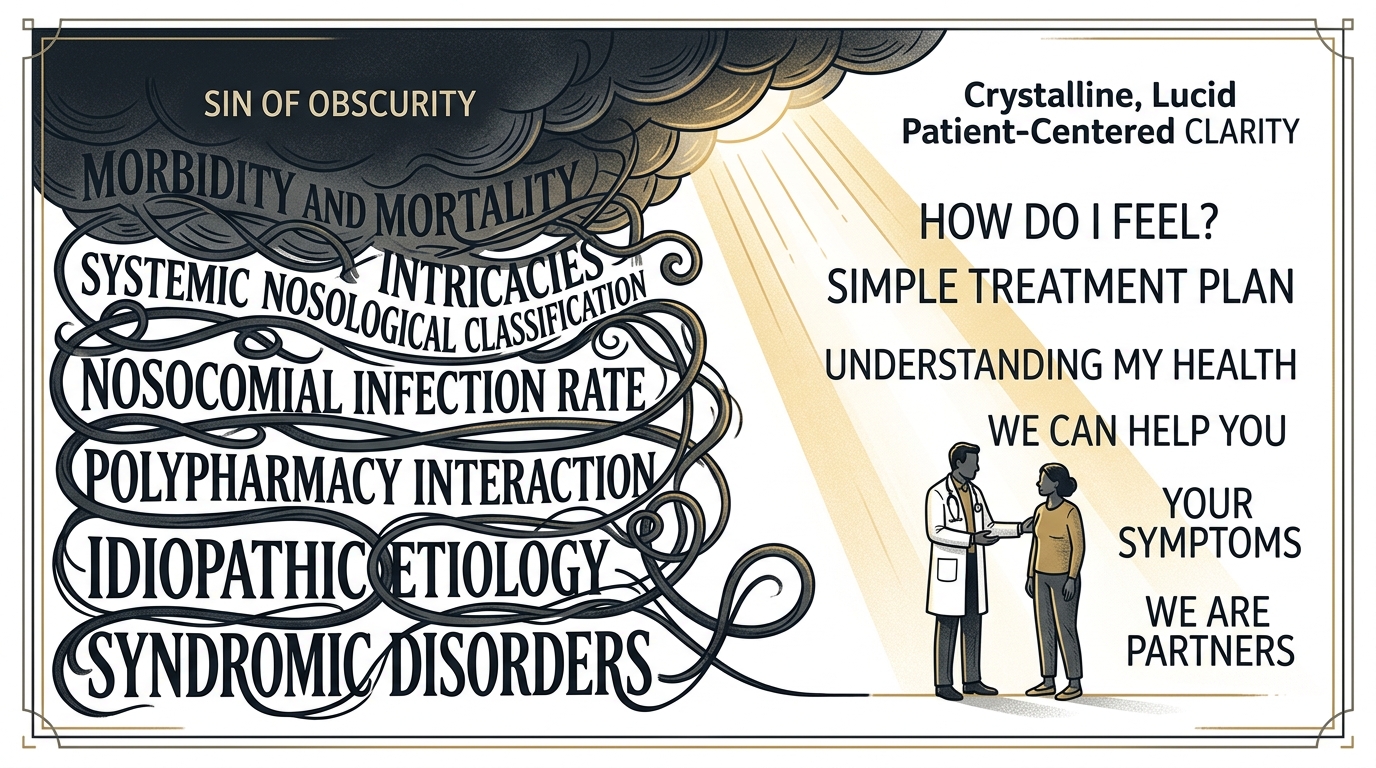
Both in writing and in lecturing clear style and short words are best. Obscurity is bad, not only because it is difficult to understand but also because it is confused with profundity, just as a shallow muddy pool may look deep. Here is an example from a recent article. The writers wanted to say: "We judge men's health by their working-places and their homes," but they imbedded their meaning in this sentence: "It is generally accepted that the evaluation of the nutritional status of a community should include assessments of the environmental conditions under which individual members live and work." As Mr. Ivor Brown1 has pointed out, such writing produces a slow weak ooze of words instead of a keen forceful jet. The double negative is a common way of making a simple statement harder to understand, and if we read "It is by no means far from infrequently that the absence of tubercle bacilli is not invariably detected," few of us can say whether tubercle bacilli are present or not (nor do we care).
I warn students taking histories against turning the simple English of their patients into the jargon of their textbooks. If a patient says "if I go half-way up a hill I feel I'm done for," these very words should appear in the notes rather than "The patient complains that during ambulation up a moderate incline he suffers a feeling of impending dissolution."
Tanto na escrita quanto nas aulas expositivas, o estilo claro e palavras curtas são o melhor caminho. A obscuridade é danosa não apenas porque é difícil de compreender, mas também porque é frequentemente confundida com profundidade — exatamente como uma poça rasa de água lamacenta pode parecer funda. Eis um exemplo de um artigo recente: os autores queriam dizer "Avaliamos a saúde dos homens pelos seus locais de trabalho e por seus lares", mas sepultaram o seu significado na seguinte frase: "É geralmente aceito que a avaliação do estado nutricional de uma comunidade deve incluir determinações das condições ambientais sob as quais seus membros individuais vivem e trabalham." Como bem apontou o Sr. Ivor Brown1, esse tipo de escrita gera um gotejar lento e fraco de palavras, em vez de um jato agudo e vigoroso. A dupla negativa é um recurso comum para tornar uma declaração simples mais difícil de entender; se lemos: "Não é de forma alguma raro que a ausência de bacilos tuberculosos não seja invariavelmente detectada", poucos de nós saberão dizer se os bacilos estão presentes ou não (e nem nos importamos).
Advirto os estudantes, ao colherem a anamnese, contra o vício de transformar a linguagem simples de seus pacientes no jargão empolado dos livros-texto. Se um paciente diz: "Se eu ando até a metade da ladeira sinto que vou morrer", são exatamente essas palavras que devem constar no prontuário, e não: "O paciente queixa-se de que, durante a deambulação em aclive moderado, padece de sensação de iminente dissolução."
Cruelty / Crueldade Mental & Física
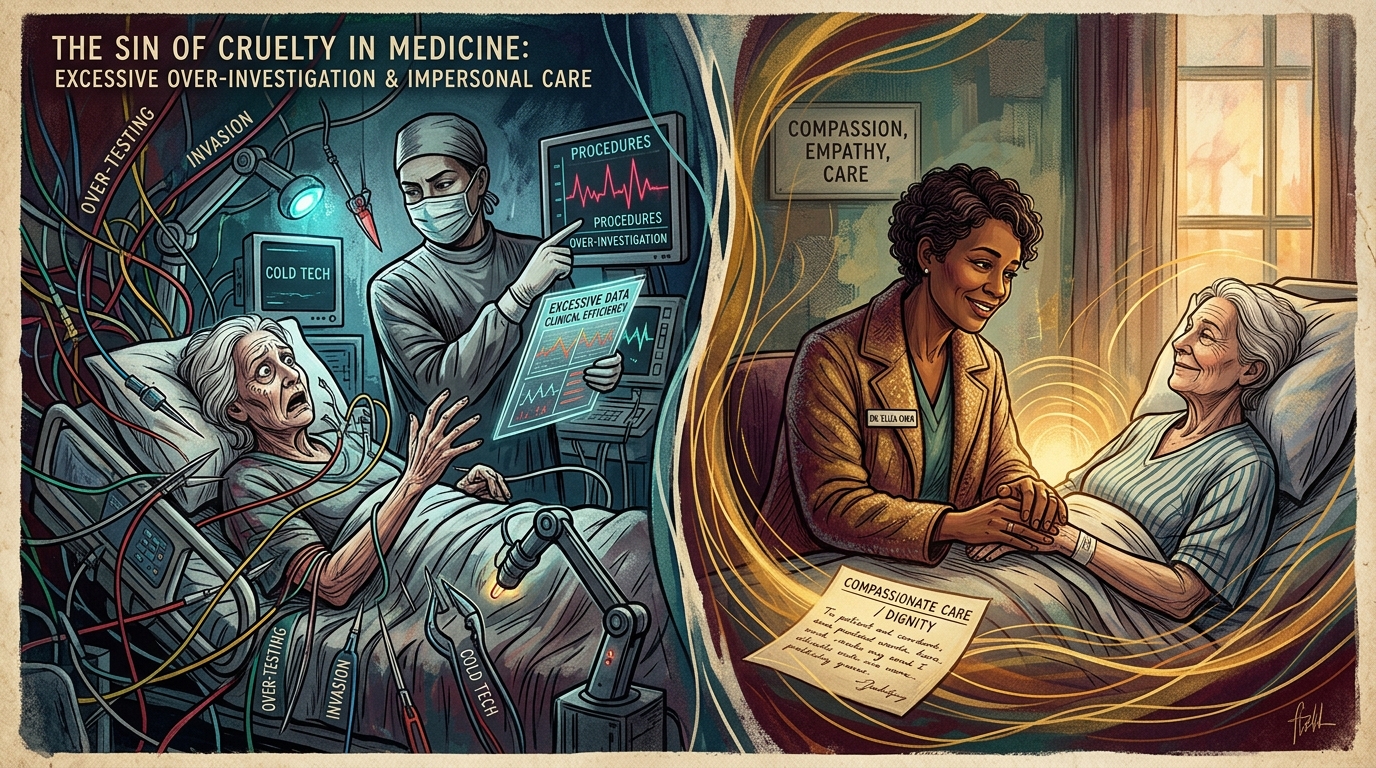
Cruelty is probably the most important and prevalent sin in the list I have chosen. Usually it is due to thoughtlessness and not deliberate. Mental cruelty is common and arises in three ways : (1) by saying too much ; (2) by saying too little ; and (3) by the patient being forgotten. By saying too much we often burden a patient with a load of anxiety which adds to the illness we are trying to relieve. Many times I have seen patients who felt well till they were told they had high blood-pressure or a heart murmur, and since that time have been afflicted with every grievous symptom which could be gathered from hearsay, from patent medicine advertisements, and from "The Home Doctor." Before telling a patient anything of his illness it is essential to consider whether it will help him or harm him, and with a little practice one soon learns what it is wise to say.
By saying too little one can cause the fear of the unknown ; the gaps may be filled in by the patient with alarming inventions and superstitions. That is why some explanation should be given to the patient who is discharged from hospital, both so that some of his groundless fears are removed and so that if he gets under the care of another doctor he can give a moderately accurate account of what he has had. The doctor should know what fears and superstitions are common among patients so that he may allay them and prevent mental cruelty. For example, a patient with shingles has nearly always been told by his grandmother that "if they meet in the middle you die," and the assurance that neither will they meet nor will he die may give him much relief. Patients with mild arthritis are usually terrified of becoming "crippled with rheumatism," and similarly many patients with bronchitis dread tuberculosis ; in these cases reassurance is more important than medicine, and it is the doctor’s duty to dig out these fears if possible.
Lastly, forgetting the patient. I refer to that kind of bedside teaching and discussion where the patient is treated as if he were unconscious, or discussed as if he already lay on the necropsy slab. It must be remembered that patients have ears, and that sotto-voce murmurings about polysyllabic diseases strike needless terror into their hearts.
Physical Cruelty
Over-investigation is a form of physical cruelty. If a man is dying of secondary cancer and the primary cancer will soon be discovered at necropsy, it is cruel to make his last days uncomfortable by playing at "hunt the primary" as one might play "hunt the slipper," and it gives extra work to the radiologists and pathologists. Patients dying of heart-failure are happier without cardiac catheters, arterial punctures, and other tests beloved of those who judge a patient with heart-failure by his cardiac output in litres per minute rather than by the number of stairs he can climb.
Here are some minor cruelties which can easily be avoided. Do not give mersalyl in the evening, so keeping the patient awake passing urine all night. Do not do a fractional test-meal on a patient with pernicious anæmia when he is admitted with a hæmoglobin in the twenties ; put his hæmoglobin up with liver treatment first—his achlorhydria will keep. Do not play at "pushing the parkinsonian" ; there are enough signs of parkinsonism to diagnose a case without pushing him in the back to see how far he totters forward. Do not put sticking plaster on hairy limbs ; you can easily shave them first. Do not wheel elaborate trolleys to a patient’s bedside and start sticking needles in him until you have given him a word of reassurance and explanation.
A crueldade é provavelmente o pecado mais importante e prevalente da lista que escolhi. Quase sempre resulta de falta de reflexão, e não de intenção deliberada. A crueldade mental é comum e surge de três maneiras: (1) por dizer demais; (2) por dizer de menos; e (3) por esquecer o paciente. Ao dizer demais, frequentemente sobrecarregamos o paciente com um fardo de ansiedade que se soma à enfermidade que tentamos aliviar. Inúmeras vezes vi pacientes que se sentiam perfeitamente bem até serem informados de que tinham pressão alta ou um sopro cardíaco, e a partir desse instante passaram a sofrer com todos os sintomas aflitivos colhidos do "ouvi dizer", de anúncios de remédios milagrosos ou do "Médico do Lar". Antes de revelar qualquer detalhe sobre a doença a um paciente, é indispensável ponderar se isso irá ajudá-lo ou prejudicá-lo; com um pouco de prática, logo se aprende o que é prudente dizer.
Por dizer de menos, podemos provocar o pavor do desconhecido; os vazios costumam ser preenchidos pelo paciente com invenções alarmantes e crendices. É por isso que alguma explicação deve ser fornecida ao paciente ao receber alta hospitalar — tanto para aplacar seus medos infundados quanto para que, caso venha a ser atendido por outro colega, consiga relatar com razoável exatidão o que teve. O médico deve conhecer os medos e superstições corriqueiros entre a população para poder desfazê-los e prevenir a crueldade mental. Por exemplo: um paciente com herpes-zóster (cobreiro) quase sempre ouviu da avó que "se as feridas derem a volta e se encontrarem no meio do corpo, você morre" — a simples garantia de que elas não se encontrarão e que ele não morrerá trará imenso alívio. Pacientes com artrite leve em geral se apavoram com o risco de ficarem "aleijados pelo reumatismo", e muitos com bronquite temem a tuberculose; nesses casos, o acolhimento e o esclarecimento são mais vitais do que o fármaco, e é dever do médico desenterrar esses temores ocultos.
Por fim, o esquecimento do paciente. Refiro-me àquele tipo de ensino e discussão à beira do leito em que o paciente é tratado como se estivesse inconsciente, ou debatido como se já estivesse estendido sobre a mesa de necropsia. Devemos sempre recordar que pacientes têm ouvidos, e que cochichos em voz baixa (*sotto-voce*) sobre doenças de nomes polissilábicos semeiam pânico desnecessário em seus corações.
Crueldade Física
A investigação excessiva (excesso propedêutico) é uma forma incontestável de crueldade física. Se um homem está em fase terminal de um câncer secundário metastático e o tumor primário em breve será descoberto na autópsia, é pura crueldade tornar seus últimos dias desconfortáveis brincando de "caçar o primário" como quem brinca de "passa-anel", além de gerar trabalho inútil aos radiologistas e patologistas. Pacientes terminais com insuficiência cardíaca sentem-se muito mais em paz sem cateterismos cardíacos, punções arteriais dolorosas e outras sondagens caras àqueles que julgam a insuficiência cardíaca pelo débito em litros por minuto, em vez de avaliá-la pela quantidade de lances de escada que o paciente consegue subir.
Eis algumas crueldades menores que podem ser facilmente evitadas: não administre diuréticos mercuriais (*mersalyl*) à noite, privando o paciente do sono ao fazê-lo urinar a noite inteira. Não realize sondagem gástrica fracionada num paciente com anemia perniciosa admitido com hemoglobina na faixa dos 20% [~3–4 g/dL]; recupere primeiro a hemoglobina com tratamento à base de fígado/vitamina — a acloridria dele pode esperar. Não brinque de "empurrar o parkinsoniano"; existem sinais clínicos de sobra para firmar o diagnóstico de parkinsonismo sem precisar empurrar o doente pelas costas para ver o quanto ele cambaleia para a frente. Não aplique esparadrapo sobre membros com pelos sem antes depilá-los com cuidado. E não empurre carrinhos repletos de bandejas cirúrgicas para a beira do leito para espetar agulhas no doente antes de dirigir a ele uma palavra serena de conforto e explicação.
Bad Manners / Maus Modos & Urbanidade
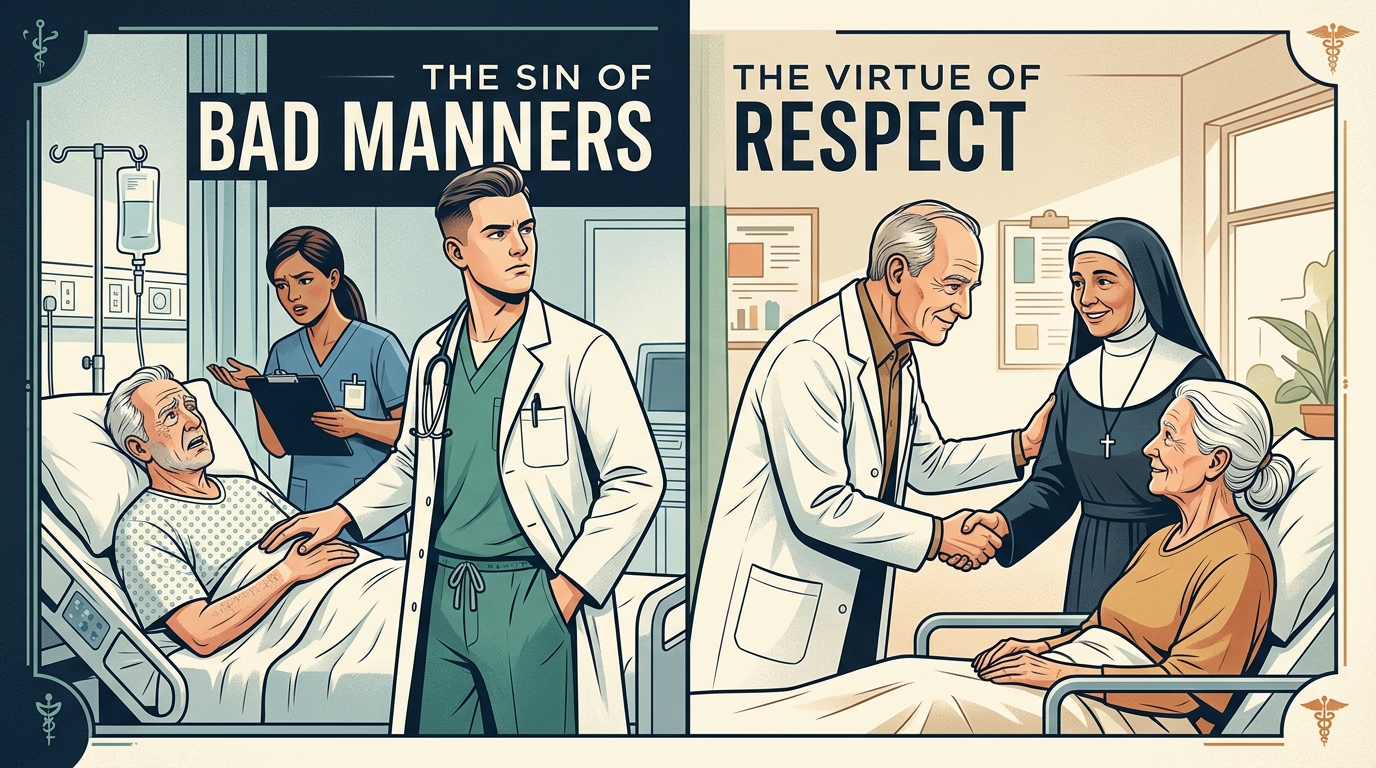
If students do not learn good manners while they are learning medicine they will be at a great disadvantage in dealing with patients, nurses, and colleagues.
Towards Patients.—I once asked a student to examine the abdomen of a patient lying in an outpatient cubicle. He dashed into the cubicle where she lay, flung back the blanket, plumped his hand on her abdomen, shouted "Gosh, what a beauty" (he was referring to the patient’s enlarged spleen and not to her personal appearance), and dashed out again. Such behaviour must be condemned.
Other forms of bad manners are (1) impatience in taking a history from a slow-witted patient ; (2) making jokes at the expense of the patient ; and (3) reading the patient’s newspaper which lies on his bed and displays headlines far more exciting than the story the patient is telling.
Towards Nurses.—Students will find that a courteous good morning to the sisters makes their access to patients and to ward equipment much easier. (In America the remark "Good morning, sister," is equivalent to saying "How goes it, honey?" and should be avoided.) Too many students or house-men call for a nurse in the manner of an impatient diner calling for a waiter.
Towards Medical Staff.—Years ago a student would take his hands out of his pockets even if a registrar passed him, and almost grovel at the sight of a chief. Perhaps the senior staff had too much majesty and pomp in those days, but the pendulum has swung in the other direction today. At any rate, I advise students not to examine an abdomen with one hand in the pocket, because it is an inefficient way of palpating ; it will irritate physicians and give a bad impression in the examination hall. In general, students should aim at a reasonable respect for their seniors but avoid an oily deference. I further caution them against bad manners when they become more senior, and suggest such courtesies as asking their colleagues’ permission before seeing a case in their wards, and writing and congratulating them on their publications or appointments.
Se os estudantes não aprenderem boas maneiras enquanto aprendem medicina, estarão em imensa desvantagem ao lidar com pacientes, equipe de enfermagem e colegas.
Com os Pacientes.—Certa vez, pedi a um estudante que examinasse o abdome de uma paciente deitada num leito de ambulatório. Ele irrompeu no cubículo onde ela estava, arrancou o cobertor, plantou a mão sobre o ventre dela, exclamou: "Nossa, que coisa linda!" (ele se referia à esplenomegalia gigante da paciente, e não aos seus atributos físicos), e saiu em disparada. Tal comportamento deve ser veementemente condenado.
Outras formas de falta de educação incluem: (1) impaciência ao colher a história de um paciente de raciocínio mais lento; (2) fazer piadas às custas do doente; e (3) pôr-se a ler o jornal do paciente deixado sobre o leito com manchetes mais chamativas do que o relato que ele está tentando contar.
Com a Enfermagem.—Os estudantes descobrirão que um cordial "bom dia" às enfermeiras-chefe facilita enormemente o acesso aos pacientes e aos materiais da enfermaria. (Nos Estados Unidos, chamar uma enfermeira de "irmã/sister" soa como "como vai, querida?" e deve ser evitado). Muitos estudantes e médicos residentes chamam uma enfermeira como um cliente impaciente chama um garçom em restaurante barato.
Com o Corpo Clínico.—Anos atrás, o estudante tirava as mãos dos bolsos mesmo que um simples preceptor passasse, e quase se prostrava ao avistar o chefe de serviço. Talvez o corpo clínico sênior desfrutasse de pompa e majestade em excesso naquela época, mas o pêndulo oscilou para o extremo oposto hoje. De qualquer modo, aconselho os estudantes a nunca examinarem um abdome com uma mão enfiada no bolso da calça: é um método ineficaz de palpação, irrita os avaliadores e causa péssima impressão nas provas práticas. Em geral, os alunos devem cultivar respeito razoável pelos mais experientes, evitando adulações servis. E recomendo ainda urbanidade quando se tornarem seniores, mantendo sutilezas como pedir licença aos colegas antes de avaliar pacientes em suas enfermarias e parabenizá-los por publicações e nomeações.
Over-specialisation / Hiperespecialização & Fragmentação
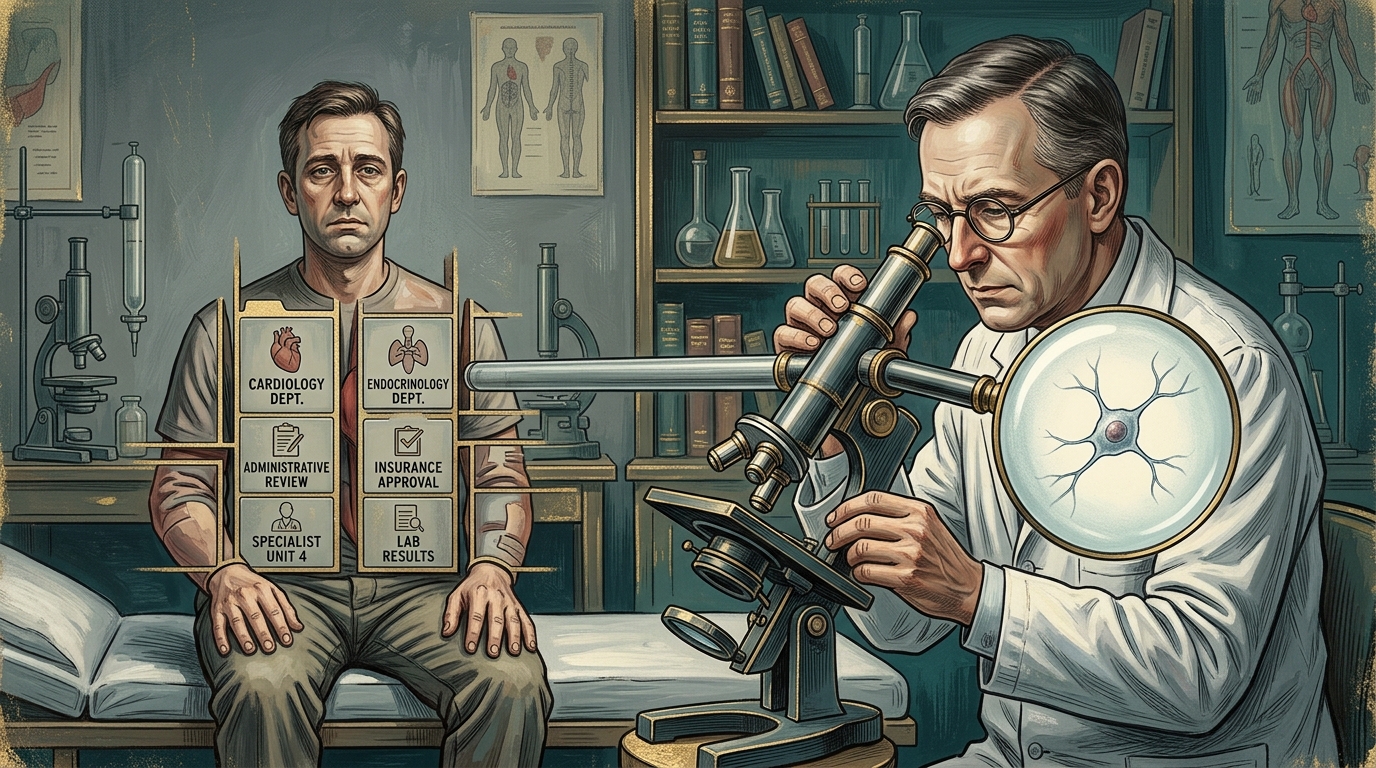
It is right that a doctor should have special interest and knowledge about one subject. It is wrong for him to show special indifference and ignorance about all other subjects. A good doctor should be a jack-of-all-trades and master of one. For example, a surgeon should be able to advise a patient with simple obesity about her diet and not refer her to an endocrine clinic ; a gynæcologist should be capable of treating a mild iron-deficiency anæmia without referring her to an anæmia clinic ; and a physician ought to squash a small ganglion on the back of the hand with his thumbs (or bible). I have known an eye surgeon after seeing a case of retinitis pigmentosa write in the notes : "This might be part of the Laurence-Moon-Biedl syndrome ; is there any evidence of polydactyly ?" For an ophthalmologist to feel himself incapable of counting fingers is surely the limit of over-specialisation ; and, if nothing is done to stop this tendency, we shall have one physician who specialises in the first heart sound, and the other who is only concerned with the second.
Perhaps the worst feature of specialisation is that it makes doctors feel they are doing wrong to deal with even the simplest case if it lies within the protected area of somebody else’s specialty. Particularly is this the case with psychiatry, which is regarded by other doctors with a mixture of suspicion, reverence, and ridicule. In Noel Coward’s "Blithe Spirit" a character, referring to psychotherapy, says : "I refuse to go through months of expensive humiliation in order to find that at the age of ten I was desperately in love with my rocking-horse." A surgeon or a physician faced with a patient exhibiting some "functional" symptoms is likely to take a similar attitude, feeling that the origin of the simplest psychoneurotic symptoms lies buried in an uncharted swamp in which only the expert can poke with impunity—a swamp crawling with complexes and repressions, where nothing is what it seems and everything symbolises something indecent. This is a foolish attitude to take ; a sensible physician or surgeon should be able to give wise counsel in the simpler case of neurosis.
Further, there is a complication of specialisation—that it allows bees to remain undisturbed within their masters’ bonnets so that the allergist looks at the world through allergic-coloured glasses and beams myopically at a world where everything is allergic.
É correto e legítimo que o médico possua interesse e conhecimento aprofundado em determinado campo. O erro reside em demonstrar indiferença e ignorância ostensivas em relação a todos os demais assuntos. O bom médico deve ser alguém capaz de resolver o geral e mestre em uma especialidade (*"jack-of-all-trades and master of one"*). Por exemplo: um cirurgião deveria ser perfeitamente capaz de orientar a dieta de uma paciente com obesidade simples, em vez de encaminhá-la ao ambulatório de endocrinologia; um ginecologista deveria conseguir tratar uma anemia ferropriva leve sem precisar despachá-la para o ambulatório de hematologia; e um clínico deveria saber drenar ou comprimir um pequeno cisto sinovial no dorso da mão com os próprios polegares (ou com a clássica Bíblia). Já presenciei um oftalmologista que, após avaliar um caso de retinite pigmentar, anotou no prontuário: "Isto pode fazer parte da síndrome de Laurence-Moon-Biedl; há evidência de polidactilia?" Um oftalmologista julgar-se incapaz de contar os dedos das mãos do paciente é, com certeza, o ápice da hiperespecialização; se nada for feito para conter essa tendência, em breve teremos um médico especialista na primeira bulha cardíaca e outro preocupado exclusivamente com a segunda.
Talvez a pior consequência da especialização seja incutir nos médicos a sensação de que estão cometendo um erro ao manejar mesmo o caso mais elementar caso ele pertença ao território demarcado da especialidade alheia. Isso se manifesta de forma gritante na psiquiatria, amiúde encarada pelos demais médicos com uma mistura de desconfiança, reverência cega e zombaria. Na peça "Blithe Spirit" de Noel Coward, uma personagem diz sobre a psicoterapia: "Recuso-me a passar por meses de humilhação caríssima apenas para descobrir que aos dez anos eu era perdidamente apaixonada pelo meu cavalinho de balanço." Um cirurgião ou clínico diante de um doente com sintomas funcionais tende a adotar postura análoga, julgando que a raiz das queixas ansiosas mais simples repousa sepultada num pântano impenetrável onde somente o especialista pode cutucar impunemente — um pântano rastejante de complexos e repressões onde nada é o que parece e tudo simboliza algo indecoroso. Esta é uma atitude tola; qualquer médico sensato deve ser capaz de oferecer aconselhamento prudente e acolhedor nos quadros neurovegetativos simples.
Existe ainda outra complicação da especialização: ela permite que certas manias e obsessões permaneçam intocadas na cabeça de seus mestres, de modo que o alergista enxerga o universo através de lentes de cor alérgica e sorri miopemente para um mundo onde qualquer espirro é uma crise imunoalérgica.
Love of the Rare (Spanophilia) / O Fascínio pelo Raro
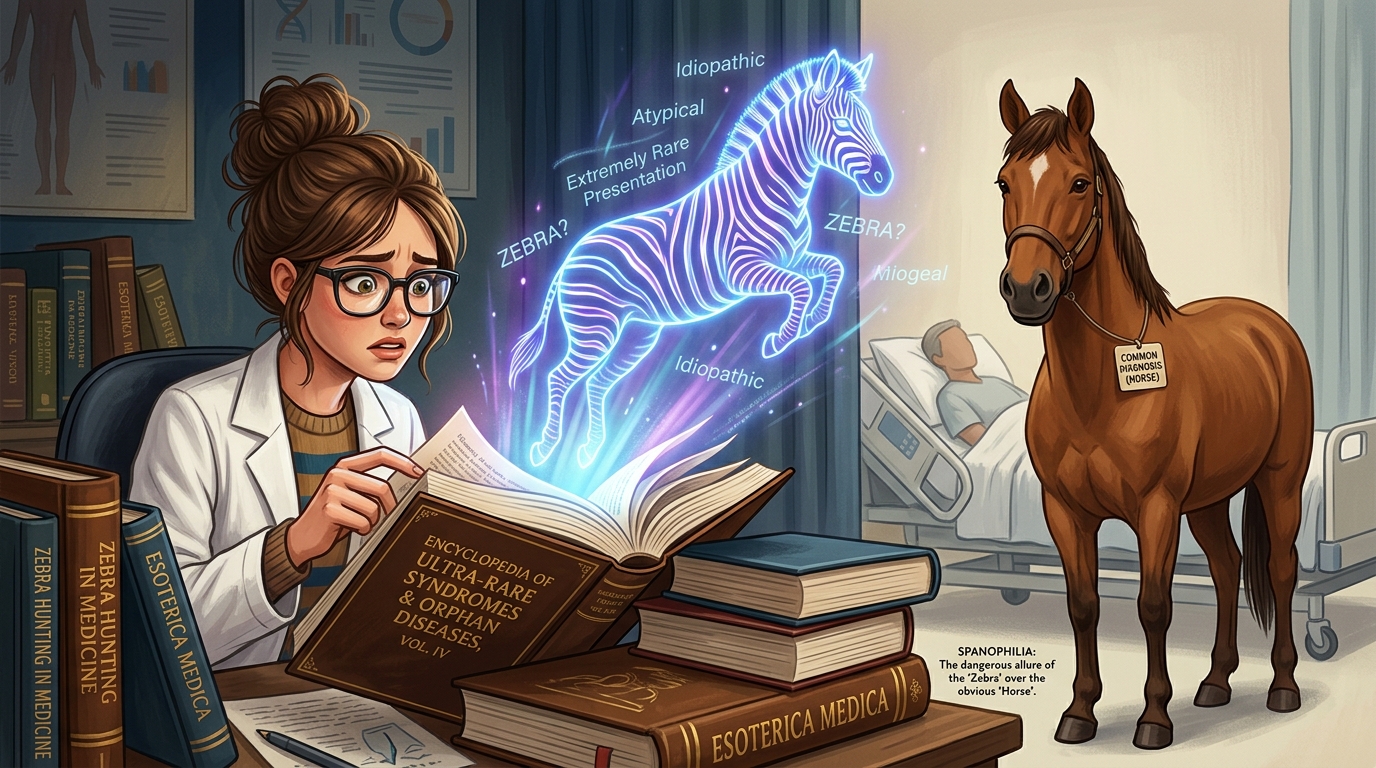
This sin is more prevalent among students, because they lack the experience that teaches which illnesses are common and which are rare. It is responsible for the failure of bookworms to pass exams. Headache and vomiting are more often due to migraine than to cerebral tumour ; nose-bleeding is more often due to picking the nose than to multiple hereditary hæmorrhagic telangiectasis ; and wasting of the small muscles of the hand occurs in old age and rheumatoid arthritis more often than in motor-neurone disease or cervical rib.
Este pecado é muito mais prevalente entre os estudantes de medicina, pela simples razão de que ainda lhes falta a vivência prática que ensina quais enfermidades são corriqueiras e quais são raríssimas. É o grande responsável pela reprovação dos chamados "ratos de biblioteca" nos exames clínicos práticos. Cefaleia e vômitos decorrem infinitamente mais de enxaqueca (migrânea) do que de tumor cerebral; sangramento nasal (epistaxe) decorre muito mais de cutucar o nariz do que de telangiectasia hemorrágica hereditária (síndrome de Osler-Weber-Rendu); e a atrofia dos pequenos músculos intrínsecos da mão ocorre na senescência e na artrite reumatoide com frequência imensamente superior à da doença do neurônio motor (ELA) ou da compressão por costela cervical.
Common Stupidity / Automatismo Terapêutico
By this I mean the opposite of common sense—common nonsense in fact. There are many kinds of this particular sin, but I think the commonest type is what might be called therapeutic automatism. No illness has a rigid code of treatment which must be advised in all circumstances ; one must cut one’s therapeutic coat according to the mental and economic cloth of one’s patient. It is mere foolishness to order an elaborate diet for a busy working-class woman with instructions to add on the fourth day 1¾ oz. of steamed red mullet to the graduated scheme prescribed.
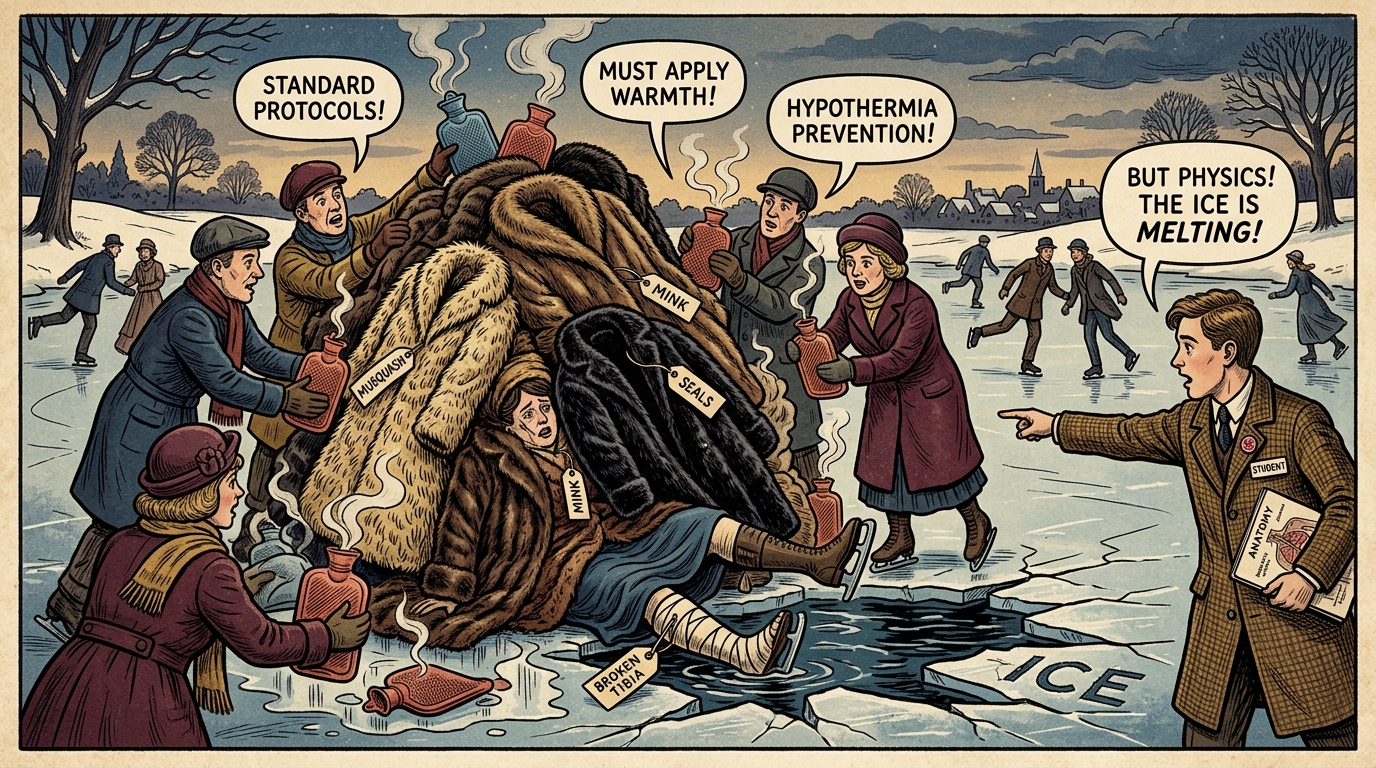
I saw the finest example of therapeutic automatism as a medical student when I was skating one winter on the local squire’s pond, watching all the quality displaying their skill. A woman fell and broke her tibia. I longed to treat her, but I was only a student. "She mustn’t be moved till the doctor comes ; we must treat her for shock," cried all the bystanders. From within the squire’s house maids hurried out with hot-water bottles, while sympathetic ladies lent their furs. Musquash was piled upon sealskin, and nutria lay upon mink. The stricken woman groaned beneath this furry mound. "The treatment of shock is always warmth" repeated the ladies (who had taken their red-cross course), but I had learned physics during my 1st M.B. and felt that another factor was at work : "Warmth may be good for shock," I thought, "but it also melts ice." It was only at the last moment that these zealous first-aiders were persuaded to abandon their treatment and drag the lady off the ice ; otherwise the patient, together with a valuable collection of furs, might have been lost. I mention this to show that patients should never be treated by rote and rule, for there may be special circumstances.
Por este pecado refiro-me ao exato oposto do bom senso — ao despropósito corriqueiro, de fato. Há inúmeras variantes dessa falha, mas considero que a mais comum é o que podemos chamar de automatismo terapêutico. Nenhuma doença possui um código rígido de tratamento que deva ser imposto cegamente em qualquer circunstância; o médico deve cortar o casaco terapêutico sob medida para o tecido mental e econômico do seu paciente. É mero desvario prescrever uma dieta sofisticada e milimetricamente pesada para uma mulher trabalhadora de classe humilde, mandando-a adicionar no quarto dia exatamente 50 gramas de filé de salmonete cozido a vapor ao esquema graduado.
Presenciei o mais perfeito exemplo de automatismo terapêutico quando ainda era estudante de medicina: estava patinando durante o inverno no lago congelado da propriedade do fidalgo local, observando a alta sociedade demonstrar sua elegância no gelo. Uma senhora caiu e fraturou a tíbia. Eu ardia em vontade de socorrê-la, mas era apenas um acadêmico. "Ela não pode ser movida até o médico chegar! Temos que tratá-la para choque!", gritavam os presentes. Da mansão do proprietário, criadas saíram correndo trazendo bolsas de água fervente, enquanto distintas senhoras emprestavam seus casacos de pele. Peles de rato-almiscarado (*musquash*) foram empilhadas sobre peles de foca, e casacos de lontra cobriam os de visom (*mink*). A pobre mulher gemia sob aquela montanha imensa de pelos. "O tratamento do choque é sempre o calor!", repetiam enfáticas as damas (que haviam feito o curso de primeiros socorros da Cruz Vermelha). No entanto, eu havia estudado física no primeiro ano de medicina e percebi que outro princípio estava em jogo: "O calor pode ser excelente para o choque", pensei comigo, "mas ele também derrete o gelo." Foi apenas no último instante que aqueles socorristas zelosos foram convencidos a interromper o tratamento e arrastar a mulher para fora do lago; do contrário, a paciente, juntamente com uma valiosíssima coleção de peles de luxo, teriam afundado no abismo d'água congelada. Menciono este episódio para demonstrar que pacientes jamais devem ser conduzidos por regras cegas e decoradas, pois sempre há circunstâncias singulares.
Sloth / Preguiça Física, Mental e Intelectual
Medical sloth can be physical or mental.
Physical Sloth
Physical sloth exists more than we like to admit. When blood-banks and standard apparatus made transfusion quick and easy, the number of transfusions quadrupled in a few years, which makes it regrettably apparent that the easiness of treatment rather than its urgency may decide whether or not it is given.
This often causes the omission of blood-pressure estimations, ophthalmoscopy, or rectal examination, and leads to lapses in aseptic ritual (if a lumbar-puncture needle touches the bed-clothes, it is tempting to pretend not to notice it). Physical sloth may also affect the overworked nurse who, tired of counting respirations, adds one more twenty to the row of twenties already on the chart, and this may stretch the doctor’s powers of belief greatly.
Mental Sloth
This is commoner and more important. Especially in history-taking is sloth the great danger. If the day is hot, the patient deaf, the doctor in a hurry, and the history garnished with reminiscences and irrelevances, it requires enormous patience and concentration to distil the essence from it. One form of unconscious sloth is worth special mention. Do not accept the patient’s diagnosis when taking a history—find out his symptoms. Rheumatic fever at the age of 10 years is important, but the patient’s statement that he had it needs amplification. He may have been one day in bed with a pain in the ankle which his aunt said was rheumatic fever or, on the other hand, may have been twelve weeks in bed with flitting joint pains of great severity starting after a sore throat. Similarly with diet (so important a part of the history in cases of anæmia), do not write "adequate" or "fair," but find out what exactly your patient eats, at each meal, and you will be astonished how many women are living on bread and margarine and countless cups of tea.
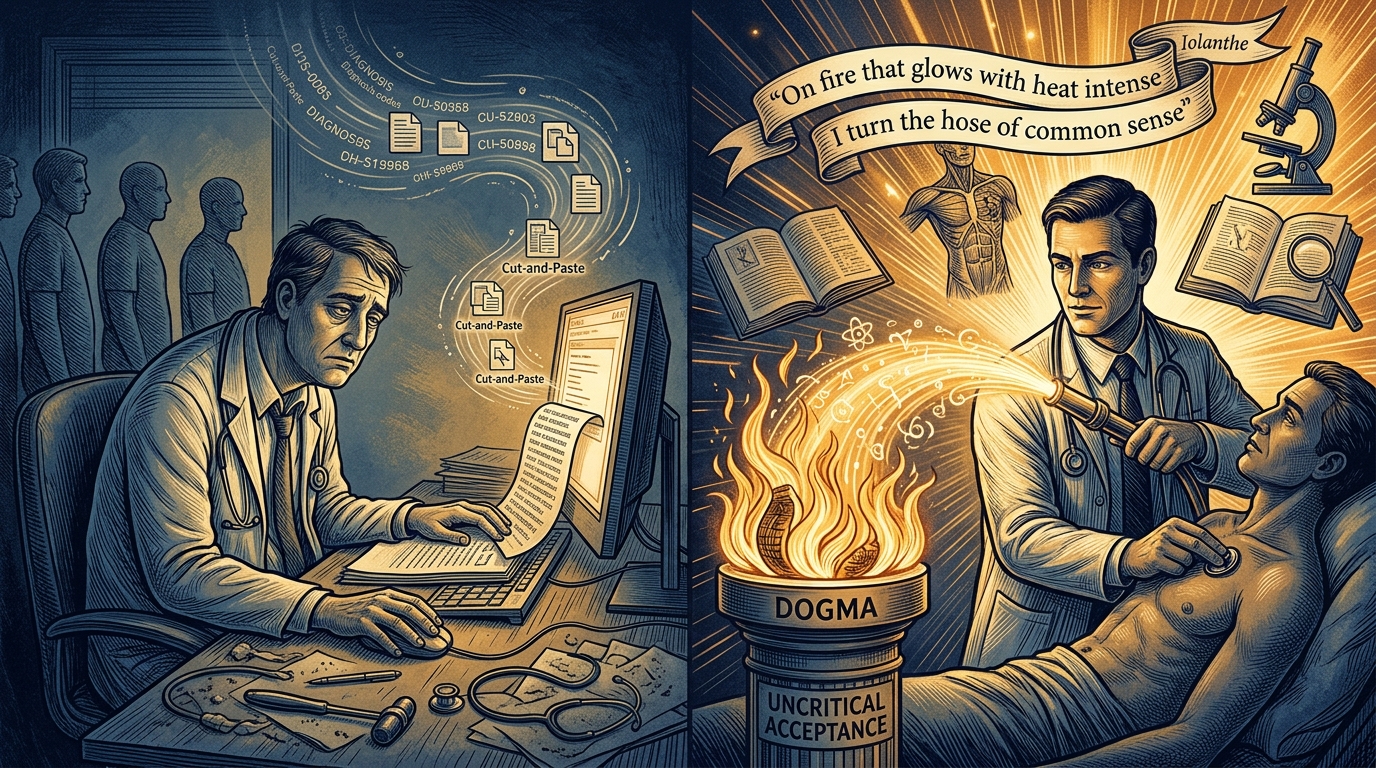
Lastly, beware of sloth in thinking. If you are too lazy to think for yourselves, you will fall an easy prey to the less thoughtful papers and publications, blindly accepting the myth and mumpsimus against which John Forbes2 has so ably warned us. If you cultivate a healthy doubt (without being unduly sceptical) you may have the experience of the Queen of the Fairies in Iolanthe :
"On fire that glows
With heat intense
I turn the hose
Of common sense
And out it goes
At small expense."
Please adopt this attitude with everything I have said, and realise that much of it may be nonsense.
A preguiça na medicina pode ser física ou mental.
Preguiça Física
A preguiça física existe com muito mais frequência do que gostaríamos de confessar. Quando os bancos de sangue e os equipamentos padronizados tornaram as hemotransfusões rápidas e fáceis, o número de transfusões quadruplicou em poucos anos — o que torna dolorosamente evidente que a facilidade de um procedimento, e não a sua real urgência clínica, muitas vezes decide se ele será prescrito ou não.
Essa preguiça é causa frequente da omissão da aferição da pressão arterial, do exame de fundo de olho (fundoscopia) ou do toque retal, além de conduzir a relaxamentos inaceitáveis da técnica asséptica (se uma agulha de punção lombar encosta sem querer no lençol da cama, há a tentação vergonhosa de fingir que não se notou). A preguiça física pode acometer também a enfermeira sobrecarregada que, exausta de cronometrar a frequência respiratória, simplesmente acrescenta mais um número "20" à fileira de "20s" já enfileirados no gráfico de sinais vitais — o que pode desafiar seriamente a capacidade de crença do médico.
Preguiça Mental
Esta é muito mais comum e perigosa. É na anamnese que a preguiça reside como o maior dos riscos. Se o dia está quente e abafado, o paciente é idoso e surdo, o médico está com pressa e o relato vem recheado de divagações e detalhes irrelevantes, exige-se imensa paciência e concentração mental para destilar o ouro essencial da história. Uma forma de preguiça inconsciente merece menção especial: nunca aceite passivamente o diagnóstico que o paciente diz ter ao colher a história — investigue detalhadamente os seus sintomas. "Febre reumática aos 10 anos" é um dado de enorme relevância, mas a simples declaração do doente de que a teve carece de rigorosa comprovação: ele pode ter passado apenas um dia na cama com dor no tornozelo e a tia disse que era febre reumática; ou, por outro lado, pode ter ficado doze semanas acamado com poliartrite migratória gravíssima iniciada após uma amigdalite purulenta. O mesmo se aplica ao inquérito alimentar (tão decisivo nos casos de anemia): nunca anote no prontuário "alimentação adequada" ou "razoável", mas descubra minuciosamente o que o paciente consome em cada refeição do dia — e você ficará estarrecido ao constatar quantas pessoas vivem exclusivamente de pão com margarina e incontáveis xícaras de chá ralo.
Por último, cuidem-se contra a preguiça de pensar. Se forem preguiçosos demais para raciocinar por conta própria, tornar-se-ão presas fáceis de artigos superficiais e publicações caça-níqueis, aceitando cegamente mitos e dogmas inveterados (*mumpsimus*) contra os quais John Forbes2 tão brilhantemente nos alertou. Se cultivarem uma dúvida metódica e saudável (sem descambar para o ceticismo estéril), poderão vivenciar a sabedoria da Rainha das Fadas na opereta Iolanthe:
"No fogo que arde
Com chama intensa
Eu viro a mangueira
Do bom senso
E o fogo se apaga
Sem grande despesa."
Peço que adotem exatamente esta mesma atitude crítica com relação a tudo o que acabei de dizer — e percebam que boa parte disto pode ser perfeito disparate.